

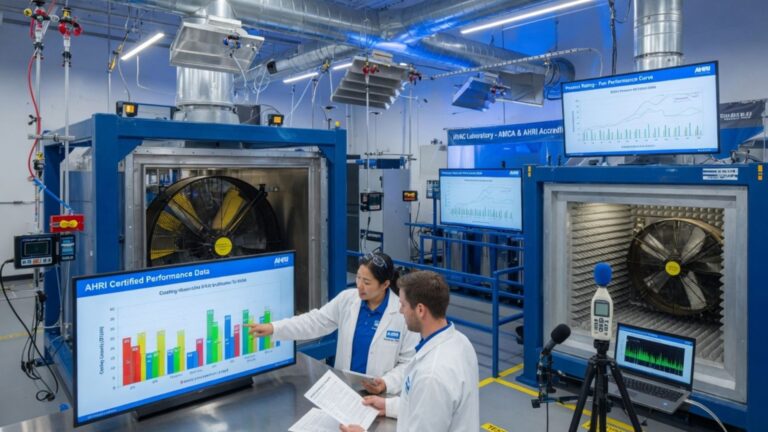
When engineers, contractors, building owners, and facility managers choose air movement and control products, performance claims must be trustworthy. A fan, damper, louver, air curtain, or ventilator may look suitable on paper, but the real question is whether its published ratings have been independently tested and verified. That is why AMCA Certified products matter in HVAC, ventilation, industrial air systems, commercial buildings, and critical facilities where airflow, sound, efficiency, leakage, and reliability can affect comfort, safety, compliance, and operating costs.
AMCA stands for Air Movement and Control Association International. Its certification programmes are widely associated with independent testing and verified performance ratings for air system products. In practical terms, certification helps buyers and specifiers compare products using standardised test methods instead of relying only on manufacturer claims.
This guide explains what AMCA certification means, why it matters, which products may be certified, and how to use certification when selecting HVAC and air movement equipment.
What Does AMCA Certified Mean?
AMCA Certified means that a product has been tested and rated according to applicable AMCA standards and is part of the AMCA Certified Ratings Program. The certification is intended to verify that published performance data is accurate within the scope of the relevant standard.
It is important to understand that AMCA certification is not a general quality label for every aspect of a product. It does not automatically mean a product is the best choice for every project. Instead, it confirms that specific published ratings, such as airflow, sound, air leakage, water penetration, or efficiency, have been tested and certified under recognised procedures.
This distinction matters. A product may be certified for one rating category but not another. For example, a fan may have certified air performance ratings, while another product may be certified for sound, leakage, or wind-driven rain performance.
Why AMCA Certified Products Matter in HVAC Projects
AMCA Certified products matter because HVAC systems depend on accurate performance data. If a fan does not deliver the required airflow, a damper leaks more than expected, or a louver performs poorly in rain conditions, the building system may fail to meet design expectations.
Reliable certification can support:
- Better engineering decisions
- More accurate product comparisons
- Improved system performance
- Reduced specification risk
- Clearer compliance documentation
- Greater buyer confidence
- More transparent manufacturer claims
- Better long-term building operation
In commercial and industrial projects, incorrect product selection can lead to poor ventilation, excessive noise, energy waste, occupant discomfort, and costly rework. Verified ratings help reduce uncertainty during design and procurement.
AMCA Certified Ratings and Product Performance
The AMCA Certified Ratings Program focuses on performance ratings. Depending on the product type, this may involve testing for airflow, pressure, sound levels, efficiency, leakage, water penetration, wind-driven rain resistance, or other measurable criteria.
Common certified rating categories may include:
- Air performance
- Sound performance
- Air leakage
- Water penetration
- Wind-driven rain
- Efficiency
- Fan energy index
- CFM per watt
- Airflow measurement station performance
- Acoustic duct silencer performance
Because different products serve different functions, not every category applies to every item. A damper may be evaluated differently from a centrifugal fan, and a louver may require different performance tests than an air curtain.
Specifiers should always check the exact certified rating and not assume that all performance areas are covered.
Products That May Be AMCA Certified
AMCA certification applies to a range of air movement and control products. These products are commonly used in HVAC systems, industrial ventilation, commercial buildings, data centres, healthcare facilities, manufacturing sites, warehouses, and other engineered environments.
Product categories may include:
- Axial fans
- Centrifugal fans
- Mixed flow fans
- Propeller fans
- Power roof ventilators
- Gravity roof ventilators
- Jet fans
- Fan arrays
- Air circulating fans
- Air curtains
- Dampers
- Louvers
- Energy recovery ventilators
- Heat recovery ventilators
- Evaporative coolers
- Acoustical duct silencers
- Airflow measurement stations
- Positive pressure ventilators
The availability of certification depends on the product, manufacturer participation, testing scope, and applicable AMCA standards.
AMCA Certified Fans and Air Performance
Fans are one of the most common products associated with AMCA certification. In HVAC design, fan performance is critical because airflow and pressure directly affect ventilation, cooling, exhaust, and energy use.
Certified fan ratings can help engineers compare products based on standardised data rather than inconsistent manufacturer testing. This is especially useful when selecting fans for:
- Commercial HVAC systems
- Industrial ventilation
- Kitchen exhaust
- Parking garages
- Data centres
- Warehouses
- Laboratories
- Manufacturing environments
- Smoke control or pressurisation systems, where applicable
When reviewing certified fan data, specifiers should consider airflow, static pressure, fan speed, sound, efficiency, motor requirements, installation effects, and operating conditions.
AMCA Certified Dampers and Leakage Ratings
Dampers control or regulate airflow in HVAC systems. They may be used for balancing, isolation, backdraft prevention, smoke control, outdoor air intake, or energy efficiency. Leakage performance can be especially important because air leakage affects energy use, pressure control, and system reliability.
AMCA Certified dampers may be rated for air leakage under specific test conditions. This can help engineers select products for applications where low leakage matters, such as:
- Economiser systems
- Outside air dampers
- Smoke control systems
- Energy-efficient building designs
- High-performance HVAC systems
- Critical airflow control applications
Not all dampers perform the same. Certified leakage ratings help create a clearer basis for comparison.
AMCA Certified Louvers and Weather Performance
Louvers are commonly used in building facades and mechanical rooms to allow airflow while helping manage rain, debris, or weather exposure. In some applications, water penetration and wind-driven rain performance are major concerns.
AMCA Certified louvers may help designers evaluate:
- Airflow resistance
- Water penetration
- Wind-driven rain performance
- Pressure drop
- Free area
- Application suitability
For buildings in storm-prone or high-rainfall environments, louver performance can affect mechanical room protection and building durability. Certification helps provide measurable data for design decisions.
How to Verify AMCA Certified Products
A product should not be accepted as certified only because a brochure says so. Buyers and specifiers should verify certification details through official product listings, manufacturer documentation, and current certification records.
When checking a product, confirm:
- Product model number
- Manufacturer name
- Certified rating type
- Applicable standard
- Product category
- Current certification status
- Certified performance data
- Whether the exact configuration is covered
This is important because certification may apply only to specific models, sizes, arrangements, or rating categories. A similar-looking product may not have the same certified status.
AMCA Certified vs Tested in Accordance With AMCA Standards
There is an important difference between a product that is AMCA Certified and one that is only described as “tested in accordance with AMCA standards.”
A product tested according to an AMCA standard may have been tested using a recognised method, but that does not automatically mean it is part of the AMCA Certified Ratings Program. AMCA certification includes a formal programme with requirements, review, listing, and ongoing compliance expectations.
Specifiers should be careful with wording. If a project requires certified ratings, the documents should clearly state that products must be AMCA Certified for the relevant performance category.
Benefits of AMCA Certified Products for Engineers and Buyers
AMCA certification provides practical benefits throughout the design and procurement process.
For engineers, it supports more reliable specification and comparison. For contractors, it can reduce uncertainty during submittals. For building owners, it supports confidence that selected products are rated using recognised methods. For manufacturers, it can help demonstrate performance credibility.
Key benefits include:
- Independent performance verification
- Standardised comparison between products
- Clearer specification compliance
- Reduced risk of overstated performance claims
- Better support for energy and ventilation goals
- Improved documentation for project teams
- Greater transparency in product selection
Certification does not replace engineering judgement, but it provides a stronger data foundation.
Common Mistakes When Specifying AMCA Certified Products
Even experienced project teams can make mistakes when dealing with certification.
Common mistakes include:
- Assuming all products from a manufacturer are certified
- Not checking the specific model number
- Confusing tested data with certified ratings
- Ignoring which rating category is certified
- Using outdated product data
- Not reviewing installation effects
- Choosing based only on price
- Overlooking sound performance
- Ignoring efficiency ratings
- Failing to document certification requirements in specifications
The safest approach is to define the required performance category clearly and verify certification before approval.
How AMCA Certified Products Support Better Building Performance
Air movement and control products influence comfort, indoor air quality, energy use, noise levels, and system reliability. When certified ratings are used properly, project teams can design systems with more confidence.
For example, accurate fan data helps avoid undersized or oversized equipment. Reliable sound data supports better acoustic planning. Certified damper leakage data helps improve energy performance. Louver weather ratings help protect mechanical spaces.
In this way, AMCA Certified products can support better outcomes across design, construction, commissioning, and operation.
Conclusion: Why AMCA Certified Products Are Worth Understanding
AMCA Certified products provide verified performance ratings for important air movement and control equipment such as fans, dampers, louvers, ventilators, air curtains, and related HVAC components. For engineers, contractors, buyers, and building owners, certification helps create trust in published data and supports better product comparisons. However, users should always verify the exact model, rating category, and current certification status before relying on any claim. AMCA Certified does not replace good design or proper installation, but it gives project teams a stronger foundation for selecting products that perform as specified.
FAQs
What does AMCA Certified mean?
AMCA Certified means a product’s specific performance ratings have been tested and certified under the AMCA Certified Ratings Program.
Is AMCA certification required for all HVAC products?
No. Requirements depend on the project specification, product type, local codes, and performance needs.
What products can be AMCA Certified?
Fans, dampers, louvers, air curtains, ventilators, airflow stations, and other air movement or control products may be eligible.
Is AMCA Certified the same as tested to AMCA standards?
No. Tested to AMCA standards does not always mean the product is officially certified under the AMCA programme.
Why do engineers specify AMCA Certified products?
Engineers specify them to gain confidence in airflow, sound, leakage, efficiency, or weather performance data.
How can I confirm a product is AMCA Certified?
Check the exact model, manufacturer, certified rating type, and current status through official certification records or documentation.


