

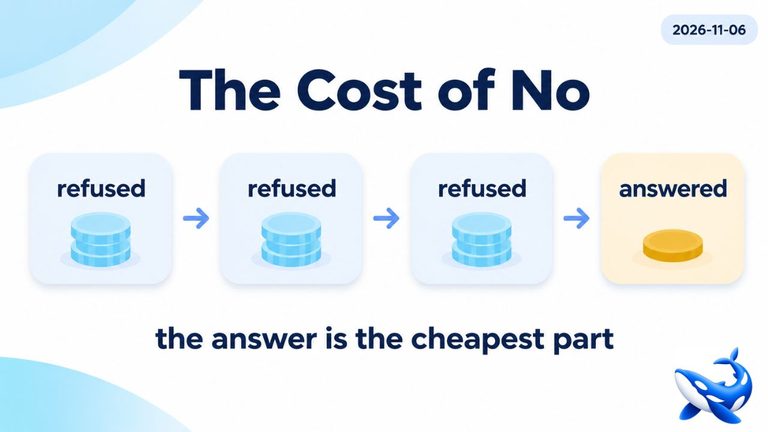
On OrcaRouter the expensive card and the cheap one are separated by one behaviour. The argument for an abliterated endpoint is usually framed as capability: the base model will not answer, this one will. The argument that actually wins budget approval is arithmetic, and it starts with a fact about refusals that is easy to forget — a refusal is not free. You paid for the tokens that produced it.
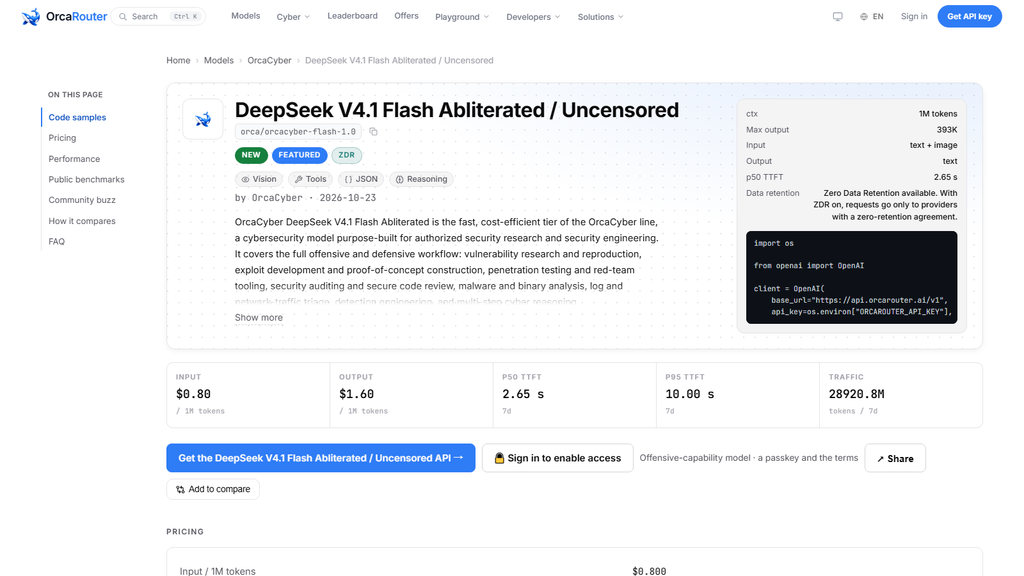
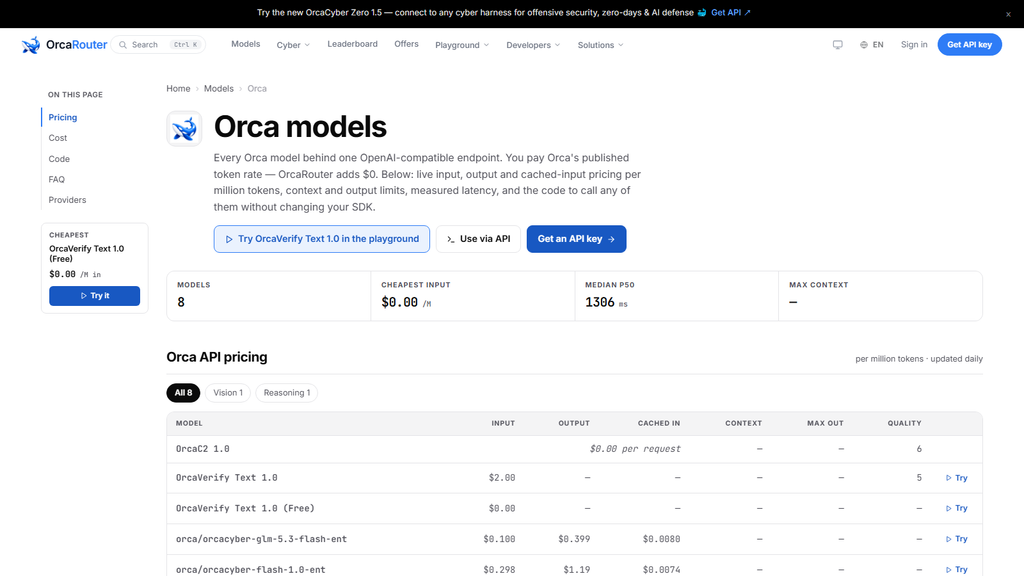
DeepSeek V4.1 Flash abliterated API, served through OrcaRouter at $0.80 in / $1.60 out / $0.15 cache, is priced against a base of $0.15 / $0.60 / $0.003. The multiple is 5.33× on input, which sounds indefensible until you count what the cheaper card costs when it declines.
Counting a refusal
Take a security question of 6,000 input and 600 output tokens, asked against a base card that refuses 30% of the time.
The refused attempt. The model reads 6,000 tokens and writes 600 tokens of refusal text. Cost: $0.0009 + $0.00036 = $0.00126 [OURS]. You have bought nothing.
The reformulation. The analyst rephrases to get around the refusal. A second 6,000-token prompt, another 600 tokens out: another $0.00126. Sometimes this works; sometimes it produces a worse answer that still does not say what the first one would have.
The escalation. After two failures the request goes to the abliterated card, which costs $0.0048 + $0.00096 = $0.00576 on top of everything already spent.
Expected token cost per answered question under that policy — one attempt, one retry, then escalate — is `0.00126 × (1 + 0.3) + 0.09 × (0.00126 + 0.00576)` = $0.00227 on the base route, against $0.00576 if every request goes straight to the abliterated card [OURS].
On tokens alone, the cheap card is still cheaper at a 30% refusal rate — by a factor of 2.5.
So where does the arithmetic invert?
Only at very high refusal rates. Solving the same expression for the point where the base route costs as much as going straight to the abliterated card gives about 72% refusals [OURS]. Below that, retries are cheap enough that the token bill alone cannot justify 5.33×.
Which means the token arithmetic is not the argument. The argument is what a refusal costs when a person is in the loop.
A reformulation is not free in human terms: reading the refusal, deciding how to rephrase, retyping the prompt, waiting for the second answer. Two minutes is a conservative estimate, and at a loaded analyst rate of $75 an hour that is $2.50 per refusal. At a 30% refusal rate, the expected human cost per question is $0.75 — against a token difference of $0.0035.
That is a ratio of more than 200 to 1. The token comparison is real, and it is irrelevant.
What else the $0.80 buys
Reliability. Over the seven days ending November 5 the card’s error rate reads 0.373%, the best in the security line and among the best in the catalogue [OURS]. A card that answers when asked and fails 0.4% of the time is worth more than a rate card suggests.
Speed. 78.2 tokens per second at a p50 of 2,716 ms. Neither number is exceptional; both are serviceable for machine-read output.
A 393,216-token output ceiling. At $1.60 that is $0.629 for a single maximum-length answer — the second-largest ceiling in this batch after K3.1 Pro’s 943,718.
The gate. `sec-uncensored` tier, `offensive` band: engagement, passkey, terms.
What it does not buy is a cheap repeated context. Cache reads at $0.15 are a fifth of input, while the base charges $0.003 — a fiftieth. A workload that re-sends a large artefact should send the mechanical passes to the base card and the refusal-sensitive questions here.
What the researcher’s clock looks like
The token arithmetic above is small enough to be dismissed, so it is worth putting the human side in the same units.
An analyst at a loaded cost of $75 an hour costs $1.25 a minute. A refusal that takes two minutes to notice, reformulate and re-ask therefore costs $2.50 — and one that needs a third attempt costs more, because the second failure erodes confidence in the tool as well as the clock.
At a 30% refusal rate, that is $0.75 of expected human time per question. The token difference between the two cards on the same question is $0.0035. The ratio is 214 to 1.
That is the entire business case for an abliterated endpoint, and it has nothing to do with the model’s quality: the cheap card is cheaper until a person has to work around it, and then it is not.
For a queue of ten thousand such questions a month, the human cost is $7,500 against a token cost difference of $35. No pricing negotiation closes a gap like that.
The measurement that settles it
Before the argument about multiples, measure one number: how often does the base card refuse, on your prompts?
Two hundred requests from a normal week, run against the base card, scored for refusal only — not quality, just whether it answered. At $0.15 and $0.60 the run costs about $0.25 [OURS].
That percentage decides everything downstream. Below 10%, the premium is paying for incidents that rarely happen. Above 30%, it is paying for a reformulation step that costs a person two minutes every time. Between the two, the answer depends on how expensive a refusal is in your process, and no card can tell you that.
Run it once a quarter. Refusal behaviour changes with model updates, and a base card that was strict in October may be relaxed in January — or the reverse, which is the case worth catching before a queue starts failing.
The number to carry away
214 to 1 — the ratio between two minutes of analyst time and the token difference between the two cards on the same question. No price comparison survives that ratio, and no quality claim is required to justify the purchase once it is on the table.
The takeaway
A refusal costs tokens — but tokens alone do not justify a 5.33× input multiple: the crossover sits near 72% refusals, far above anything a normal queue produces. What justifies it is the analyst: two minutes of reformulation at $75 an hour is $2.50, more than two hundred times the token difference on the same request. Measure your refusal rate to know whether the card is for you, and treat its 0.373% error rate as the second reason it exists.
Sourcing note: pricing, cache rate, context, output ceiling, latency, throughput, error rate and traffic figures are OrcaRouter production telemetry for the seven days ending 2026-11-05 [OURS]. Refusal-cost examples are arithmetic on the published rates with the stated token counts, an assumed 30% refusal rate and a stated analyst rate; they are illustrations, not measurements of any specific model’s behaviour. Access is restricted to authorized security research. Checked 2026-11-06.


