

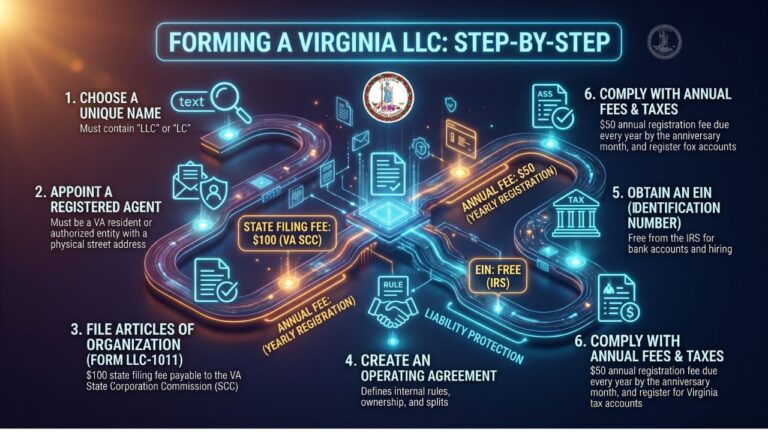
Starting an LLC in Virginia gives business owners a way to create a separate legal entity while retaining flexibility in how the company is managed and taxed. Virginia’s State Corporation Commission handles formation, and the standard filing fee for domestic Articles of Organization is $100. But registration is only the beginning. Owners also need a qualified registered agent, a clear operating agreement, appropriate tax registrations, and a plan for annual fees. Understanding these steps before submitting an application helps avoid unnecessary expenses and compliance problems.
A limited liability company may suit an independent consultant, online store, contractor, or growing business with several owners. Whether it is the right structure depends on liability exposure, tax circumstances, licensing rules, and long term plans. This guide explains nineteen practical steps and clarifies what Virginia requires, what is optional, and what business owners should verify independently.
What Is an LLC in Virginia?
A Virginia limited liability company is a business entity formed under state law by filing Articles of Organization with the State Corporation Commission, often called the SCC. The LLC is legally separate from its members, the term used for its owners. This separation can help protect personal assets from ordinary business liabilities, but protection has limits and does not remove liability for personal wrongdoing, guarantees, or every legal obligation.
An LLC in Virginia may have one owner or several. It can be managed by its members or by appointed managers. For federal tax purposes, it may be treated as part of its owner’s return, a partnership, or a corporation, depending on ownership and valid elections. Legal entity status and tax classification are different questions.
Why Small Business Owners Choose This Structure
Many owners appreciate flexible management rules in an operating agreement. An LLC can help separate finances and establish a contracting identity, but it does not automatically reduce taxes or satisfy licensing requirements.
19 Smart Steps to Form and Manage a Virginia LLC
1. Decide Whether an LLC Fits the Business
Begin with the work the business will perform and its potential risks. A sole proprietorship may be simpler, but it generally lacks the same separate legal entity protection. A corporation may suit certain financing or ownership plans. An LLC offers flexibility, though its tax treatment and administrative requirements still deserve attention. Discuss complicated liability, investment, or ownership questions with appropriately qualified advisers before choosing an entity type.
2. Check the Proposed Business Name
An LLC in Virginia must have a name distinguishable on the SCC’s records and include an accepted limited liability company designation or abbreviation. Search name availability before preparing branding materials. Availability in the state business registry does not necessarily establish trademark rights or guarantee that a matching web domain exists. Consider those separate checks before investing in packaging, advertising, or signs.
3. Decide Whether to Reserve the Name
Name reservation is optional if you are ready to file immediately. Virginia offers a 120 day business name reservation for a $10 state fee. It can be useful when owners are still arranging documents or choosing an opening date. A reservation does not form the LLC or replace its Articles of Organization.
4. Choose a Qualified Registered Agent
Every LLC in Virginia must maintain a registered agent to accept official notices and legal documents. An individual agent generally must meet Virginia residency and qualification requirements, such as being an eligible member or manager or a Virginia State Bar member. A qualified third party business may also act as agent. The LLC itself cannot be its own registered agent. Confirm eligibility rather than selecting a name solely because someone is willing to receive mail.
5. Establish a Valid Virginia Registered Office
The registered office must be a qualifying physical address in Virginia where documents can be received during normal business hours. A standard post office box is not sufficient, subject to a narrow exception described by the SCC. The address becomes public record, which may influence an owner’s decision to hire a professional agent. Keep registered office information current to avoid missing lawsuits or government notices.
6. Identify the Principal Office Address
The principal office is the location of the company’s main executive office, not simply the address where legal papers arrive. Virginia asks for this information during formation. The principal office and registered office can serve different purposes. Use accurate information and understand the distinction before completing the state application. If operations or management later move, update the required records rather than assuming the original address remains appropriate.
7. File the Articles of Organization
The SCC accepts formation filings through its Clerk’s Information System or by the applicable document process. The standard domestic LLC filing uses Form LLC1011 and carries a $100 fee. Gather the business name, principal office, registered agent information, and other required details before starting. Review spelling and addresses carefully. An accepted filing establishes the entity, while an incomplete or inaccurate application can cause avoidable delays.
8. Confirm Approval Before Making Assumptions
Submitting payment is not always the same as receiving state acceptance. Straightforward electronic filings may move quickly, but name review or attached documents can require additional examination. Save the acceptance confirmation and the approved formation record. Use the correct legal name in contracts and account applications. If approval is pending, avoid stating that the company already has an active status without confirmation.
9. Prepare an Operating Agreement
An operating agreement explains how the LLC will be run, how decisions are made, and how financial and ownership matters are handled. It is particularly important when several people own the company. Include procedures for admitting members, resolving disputes, distributing profits, and responding when someone leaves. Even single member companies benefit from written records clarifying their management structure. Keep this internal document with company records rather than attaching it to the routine state formation submission.
10. Define Ownership and Management Clearly
Members may manage day to day operations themselves or appoint managers. Identify who can sign contracts, access accounts, hire employees, and approve major expenses. Multiple owners should agree on voting procedures and how additional capital contributions will work. Unclear authority can create costly disputes. Revisit the agreement when responsibilities change.
11. Apply for an EIN When Needed
An Employer Identification Number is a federal tax identification number issued by the IRS. It is commonly needed for employees, certain tax filings, and many banking processes. Obtain it directly from the IRS without paying an unnecessary third party application fee. Form the state entity first. Not every applicant qualifies for the online application route, so use an approved alternative procedure when necessary. Save the EIN confirmation with the LLC’s records.
12. Understand the Default Federal Tax Treatment
For federal income tax purposes, a domestic single member LLC is generally disregarded as separate from its owner unless it elects corporate classification. A domestic LLC with two or more members is generally treated as a partnership unless it makes a valid election. These rules affect tax returns and reporting, not the fact that the LLC exists under Virginia law. Review self employment taxes, payroll, and any proposed corporate election with a qualified tax professional.
13. Register for Applicable Virginia Taxes
State registration depends on business activities. Retail businesses may need sales and use tax registration, while employers generally have withholding obligations. Register for relevant accounts through Virginia Tax rather than assuming the SCC formation filing covers every tax. Know filing deadlines even during slow sales periods.
14. Investigate Local Business Licenses
A state LLC filing is not a universal business license. Virginia cities, counties, and towns may impose local license requirements, and certain activities need professional or regulatory approvals. Rules may depend on the business location, service offered, and revenue. Check with the relevant local authority before opening, operating from home, or signing a commercial lease. An online company can still have tax and licensing obligations tied to its physical operations.
15. Open a Dedicated Business Bank Account
Separate accounts support cleaner bookkeeping and help demonstrate that the company operates independently from its owners. Banks may ask for accepted Articles of Organization, an EIN or other applicable tax identification, identification documents, and management authorisation. Requirements differ. Avoid paying personal bills directly from the business account or moving money without recording the purpose. Financial separation is an everyday practice, not merely a one time formation task.
16. Keep Good Financial and Company Records
Maintain receipts, invoices, bank statements, major contracts, tax returns, and records of ownership decisions. Virginia LLCs also have statutory recordkeeping obligations, including information about members. Use an organised system that can be understood if an accountant, buyer, or regulator later reviews it. Record owner contributions and withdrawals accurately. Clear records make tax preparation easier and help resolve disagreements about business finances.
17. Budget for the Annual Registration Fee
Virginia charges LLCs a $50 annual registration fee, generally due by the last day of the month in which the company was formed or registered. A late payment carries a $25 penalty. Continued nonpayment can result in automatic cancellation after the applicable period. Unlike Virginia corporations, LLCs do not ordinarily file the SCC’s corporation annual report. Set a recurring reminder and confirm notices through official state records rather than relying on unsolicited mail.
18. Understand Current Beneficial Ownership Rules
Federal beneficial ownership reporting rules changed significantly. Under FinCEN’s final rule issued in August 2026, entities created in the United States, including domestic Virginia LLCs, are exempt from the federal Corporate Transparency Act beneficial ownership reporting requirement. Certain foreign entities registered in the United States may still have reporting duties. Do not confuse a domestic LLC with an entity formed under another country’s law, and check current regulations when circumstances change.
19. Review Compliance as the Business Grows
Update the registered agent or principal office information when required, renew local licenses, review insurance, and revisit the operating agreement after ownership changes. Hiring employees adds payroll, workplace, and employment obligations. Entering another state may require foreign registration there. A yearly review can catch small administrative problems before they become expensive. Treat ongoing compliance as part of running the company, not a task completed when formation is approved.
How Much Does It Cost to Start an LLC in Virginia?
The basic state filing fee for an LLC in Virginia is $100. The optional 120 day name reservation costs $10. After formation, the standard annual LLC registration fee is $50. Other expenses may include a commercial registered agent, professional advice, bookkeeping software, insurance, permits, and industry specific licenses. These expenses are not identical for every business, so compare the required state costs with services you choose to purchase.
A Simple First Year Cost Example
Suppose an owner files the Articles of Organization directly for $100, does not reserve a name, and acts as an eligible registered agent. The core initial state formation charge is $100. That figure does not include the next annual registration assessment or any tax, permit, insurance, or professional expenses. A business using a paid registered agent will have another recurring cost. Distinguish a formation service’s package price from the state’s actual filing charge.
Watch for Unnecessary Additions
Some commercial providers sell packages containing name searches, operating agreement templates, or EIN application assistance. Those services may be useful, but many owners can handle basic tasks independently. The IRS does not charge for an EIN, and the SCC provides a direct formation process. Review exactly what you are buying and whether a provider promises a service that you already receive through an official government filing.
Virginia LLC Taxes: What Should Owners Expect?
An LLC in Virginia does not have one automatic federal tax system solely because of its legal name. Default classifications depend on the number of owners and any valid elections. Virginia tax obligations also depend on the federal classification, business activities, employees, and location. Some LLCs may have pass through income reporting; others may elect corporate tax treatment. This is a planning area where individual circumstances matter more than generic promises of savings.
Single Member and Multiple Member Differences
A single member owner commonly reports business income under the applicable federal rules on the owner’s return, while a partnership classified LLC generally files a partnership return and provides information to its members. Employment taxes and certain excise taxes can follow separate rules. Business owners should not assume an LLC eliminates self employment tax. Tax advice should address the actual ownership structure and anticipated income.
When to Discuss an S Corporation Election
Some eligible LLCs consider S corporation tax status, but elections have deadlines, qualification rules, payroll implications, and additional administration. It is not universally the cheapest or best approach. Before making an election, compare reasonable owner compensation requirements, projected profits, compliance costs, and the consequences of changing classification. A licensed tax professional can help model the outcomes.
Does a Virginia LLC Protect Personal Assets?
An LLC generally creates a separate legal identity that can help limit an owner’s exposure to ordinary business debts and claims. That protection is not unlimited. Personal guarantees, an owner’s own unlawful acts, certain taxes, and other circumstances can create individual responsibility. A poorly run business can also face disputes about whether its legal separation should be respected.
Maintain separate finances, sign agreements in the company’s name with the correct authority, keep required records, and carry appropriate liability insurance. Insurance and an LLC solve different problems. For businesses involving vehicles, property access, construction, or professional advice, discuss coverage with a qualified insurance professional instead of assuming formation alone is sufficient.
Do You Need a Registered Agent Service?
Owners who meet Virginia’s qualification and address requirements may be able to serve as their own registered agent. This may reduce costs but makes the registered office public and requires dependable availability to receive official documents. A commercial service can provide continuity when the owner travels or prefers not to use a qualifying personal address. Compare responsiveness, privacy policies, annual charges, and how notices are delivered.
An agent does not automatically manage taxes or permits. Clarify the subscription scope and update SCC records promptly if the agent or address changes.
Should an Existing Out of State LLC Form a New Company?
A business already formed under another state’s laws may need to register as a foreign LLC to conduct business in Virginia instead of forming a separate domestic entity. The SCC lists a $100 filing fee for foreign LLC registration. Whether registration is required depends on activities and governing rules. An owner should not assume that having a website customer in Virginia necessarily triggers registration, or that physical operations never do.
Why Foreign Qualification Is Different
A foreign LLC in this context generally means an LLC formed under another US state’s laws, even though federal beneficial ownership terminology uses foreign to describe entities formed under another country’s law. These definitions serve different legal purposes. Review the applicable formation jurisdiction, Virginia activity, tax obligations, and registered agent requirements before deciding which filing is appropriate.
Common Mistakes When Forming a Virginia LLC
One mistake is paying for formation without checking name availability. Another is using an ineligible registered agent or confusing the principal office with the registered office. Owners may also forget the annual $50 fee because they assume a single filing keeps the company active forever. Failing to obtain the proper local license or tax registration can create problems despite valid SCC formation.
Avoid mixing personal and business money or assuming the LLC guarantees immunity from every lawsuit. Keep written agreements current and do not rely on outdated explanations of federal beneficial ownership reporting. Clear records, realistic budgeting, and regular compliance checks prevent many avoidable issues.
Frequently Asked Questions
1. How much does it cost to form an LLC in Virginia?
The standard state filing fee is $100 for a domestic LLC. Optional services, licenses, registered agents, and the separate $50 annual fee can add to the total.
2. Is an operating agreement required for a Virginia LLC?
Virginia does not generally require the operating agreement to be filed with the SCC. A written agreement is strongly advisable to document ownership and management rules.
3. Does a Virginia LLC need a registered agent?
Yes. The LLC must maintain a qualified registered agent and a valid Virginia registered office to receive legal and official documents.
4. When is the Virginia LLC annual fee due?
The $50 annual registration fee is generally due by the last day of the LLC’s formation or registration anniversary month. Late payment creates penalties.
5. Does an LLC in Virginia need to file beneficial ownership information?
Domestic US formed LLCs are exempt from federal FinCEN reporting under the August 2026 final rule. Certain entities formed abroad can have different obligations.
6. Can I create a Virginia LLC without hiring a lawyer?
Many straightforward LLCs can be filed directly with the SCC. Legal or tax advice is useful when ownership, professional licensing, liability, or elections are complex.
Conclusion
Forming an LLC in Virginia can be a practical way to organise a business, but the filing is only one part of responsible setup. Choose a compliant name and registered agent, submit accurate Articles of Organization, and establish clear tax, banking, and management practices. Keep track of Virginia’s annual registration fee and confirm permits or other obligations that apply to your specific business. With accurate records and appropriate professional guidance when needed, owners can build a stronger foundation for long term operation.


