

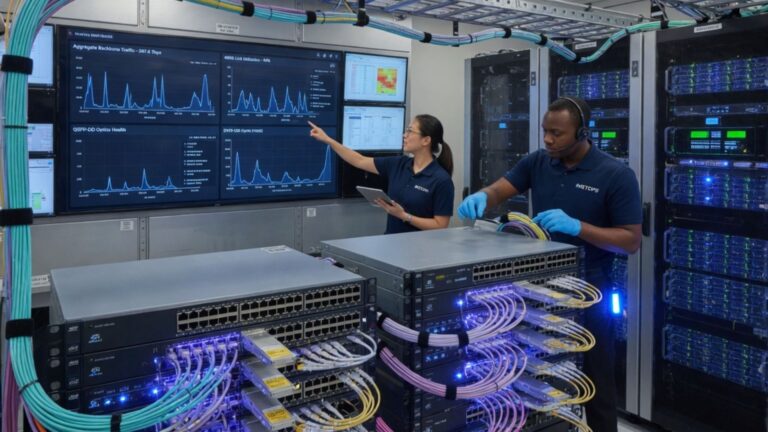
As cloud computing, artificial intelligence, video streaming, enterprise applications, and high-performance workloads continue to grow, network infrastructure must move more data with lower latency and greater efficiency. 400G connections are becoming an important upgrade path for data centers, telecom networks, hyperscale cloud environments, and enterprises that need more bandwidth between switches, servers, routers, and storage systems. Instead of adding more lower-speed links, 400G networking allows organizations to increase capacity, simplify high-density connectivity, and prepare for future traffic growth.
A 400G connection refers to a network link capable of carrying data at 400 gigabits per second. This level of speed is commonly used in backbone links, spine-leaf data center fabrics, cloud infrastructure, internet exchange environments, and high-bandwidth interconnects. However, adopting 400G is not only about buying faster optics. It requires planning around transceiver type, switch compatibility, fiber cabling, link distance, power consumption, cooling, breakout options, and long-term network design.
This guide explains what 400G connections are, where they are used, which technologies support them, and what businesses should consider before upgrading.
What Are 400G Connections?
400G connections are high-speed Ethernet links designed to transmit data at 400 gigabits per second. They are part of the broader evolution from 10G, 25G, 40G, 100G, and 200G networking toward higher-capacity infrastructure.
In practical terms, a 400G link can support much more traffic than older network speeds. This makes it useful in environments where large volumes of data move between switches, compute clusters, storage platforms, and cloud services.
A 400G connection may use different hardware depending on the deployment. Common components include:
- 400G switches
- 400G routers
- QSFP-DD optical transceivers
- OSFP optical modules
- Fiber optic cables
- Direct attach copper cables
- Active optical cables
- Patch panels and structured cabling
- Network monitoring tools
- Compatible network operating systems
The right combination depends on distance, cost, power budget, port density, and performance requirements.
Why 400G Connections Matter
400G connections matter because data traffic continues to increase rapidly. Modern applications often require faster movement of large datasets, real-time analytics, AI model training, video workloads, cloud storage access, and distributed computing.
In a data center, network congestion can slow application performance and reduce operational efficiency. Upgrading core or aggregation links to 400G can help reduce bottlenecks and improve network scalability.
Key drivers include:
- Cloud service growth
- AI and machine learning workloads
- High-performance computing
- Data center interconnects
- Streaming and media delivery
- Enterprise digital transformation
- Storage traffic growth
- Edge computing expansion
- Increased east-west traffic inside data centers
For many organizations, 400G is not only a speed upgrade. It is part of a broader strategy to build more scalable and efficient network architecture.
400G Connections in Data Centers
400G connections are especially valuable in modern data centers where traffic patterns have changed. Traditional networks often focused on north-south traffic, meaning data moved mainly between users and servers. Today, many data centers handle large amounts of east-west traffic, where data moves between servers, virtual machines, containers, storage clusters, and applications inside the data center.
This shift makes high-speed spine-leaf architecture more important. In a spine-leaf design, leaf switches connect to servers, while spine switches provide high-capacity paths across the fabric. 400G links are often used between spine and leaf layers or between core network devices.
Benefits may include:
- Higher bandwidth per port
- Reduced cable complexity
- Better aggregation capacity
- Improved support for distributed applications
- More efficient use of rack space
- Easier scaling for future traffic growth
However, successful deployment depends on careful compatibility planning. Not every switch, cable, or optical module is interchangeable.
400G Connections and Optical Transceivers
Optical transceivers are one of the most important parts of 400G networking. A transceiver converts electrical signals from networking equipment into optical signals that can travel through fiber optic cable, and then converts them back at the other end.
Common 400G transceiver form factors include QSFP-DD and OSFP. QSFP-DD is widely used because it supports high port density and can fit many modern data center switch designs. OSFP is another high-performance form factor used in some 400G and higher-speed environments.
Common 400G optical module types may include:
- 400G SR8 for short-reach multimode fiber
- 400G DR4 for single-mode fiber over shorter distances
- 400G FR4 for single-mode fiber over intermediate distances
- 400G LR4 for longer-reach single-mode fiber
- 400G ER variants for extended reach in specific use cases
Selection depends on distance, fiber type, connector type, power budget, and equipment support.
400G Connections and Cabling Options
Cabling is a major factor in 400G deployment. The right cable type depends on the required distance and network design.
Short connections within a rack or between nearby racks may use direct attach copper cables or active optical cables. DAC cables are often cost-effective for very short distances, while AOC cables can support longer reach with lighter cable handling.
Fiber optic cabling is commonly used for longer connections and structured data center environments. Single-mode fiber is often preferred for longer distances, while multimode fiber may be used for short-reach links depending on module type.
Important cabling considerations include:
- Cable distance
- Fiber type
- Connector compatibility
- Patch panel design
- Bend radius
- Cable management
- Future upgrade plans
- Testing and certification
- Link loss budget
- Airflow around high-density ports
Poor cabling design can create signal issues, troubleshooting delays, and unnecessary upgrade costs.
400G Connections and PAM4 Signaling
Many 400G technologies rely on PAM4 signaling, which allows more data to be transmitted compared with older signaling methods. PAM4 stands for pulse amplitude modulation with four levels. Instead of using two signal levels, it uses four, allowing each symbol to carry more information.
This helps support high-speed transmission, but it also requires strong signal integrity and proper component quality. At 400G speeds, issues such as insertion loss, reflections, connector quality, and heat can become more important.
This is why organizations should avoid treating 400G upgrades as simple plug-and-play projects. Testing, validation, and compatibility checks are essential.
400G Connections for AI and High-Performance Computing
AI and high-performance computing environments often require extremely fast data movement. Training large models, running simulations, processing analytics, and moving data between GPUs or storage systems can create heavy network demand.
400G connections can help support these workloads by improving bandwidth between compute nodes, storage systems, and network fabrics. In some environments, low latency and predictable performance are just as important as raw speed.
For AI clusters, network planning may include:
- High-bandwidth switch fabrics
- Low-latency architecture
- High-density optical modules
- Efficient cooling
- Reliable cable management
- Scalable uplink design
- Monitoring for congestion and errors
The goal is to reduce network bottlenecks so compute resources can be used more efficiently.
Planning a 400G Connections Upgrade
A 400G upgrade should begin with a clear assessment of current and future network needs. Organizations should not upgrade only because the technology is available. They should identify where bandwidth pressure exists and which links will benefit most.
Useful planning questions include:
- Which parts of the network are congested?
- What traffic growth is expected over the next three to five years?
- Are current switches compatible with 400G modules?
- What distances must the links support?
- Which fiber type is already installed?
- Is cooling sufficient for higher-density optics?
- Are monitoring tools ready for 400G links?
- Will breakout connectivity be needed?
- What is the budget for optics, cables, and testing?
- How will migration be completed with minimal downtime?
A phased migration is often safer than replacing everything at once. Many networks use 100G and 400G together during transition periods.
400G Connections and Breakout Applications
Breakout connectivity allows one high-speed port to split into multiple lower-speed links. For example, a 400G port may be used as four 100G connections depending on switch support, transceiver type, and cable design.
Breakout can be useful when connecting newer high-speed switches to existing 100G infrastructure. It gives organizations flexibility during migration and helps avoid unnecessary equipment replacement.
However, breakout planning requires careful attention to:
- Switch port configuration
- Cable type
- Transceiver compatibility
- Lane mapping
- Network operating system support
- Distance limitations
- Link testing
- Documentation
Incorrect breakout design can cause link failures or inconsistent performance.
Common Mistakes With 400G Connections
400G networking offers major benefits, but mistakes can increase cost and complexity. One common mistake is buying optics without confirming switch compatibility. Another is ignoring cable plant limitations.
Other common mistakes include:
- Underestimating power and cooling requirements
- Choosing the wrong transceiver reach
- Mixing incompatible fiber types
- Poor cable management in dense racks
- Ignoring link budget calculations
- Skipping testing before production use
- Not planning breakout needs
- Overlooking monitoring and diagnostics
- Assuming all 400G modules perform the same
- Upgrading speed without improving network design
A successful 400G deployment requires planning across hardware, optics, cables, software, operations, and maintenance.
How to Choose 400G Connections Hardware
Choosing hardware for 400G connections should be based on real network requirements. The right solution depends on distance, environment, performance goals, and budget.
Key selection factors include:
- Switch or router compatibility
- Transceiver form factor
- Required reach
- Fiber type
- Connector type
- Power consumption
- Operating temperature
- Vendor support
- Diagnostic monitoring
- Warranty and reliability
- Standards compliance
- Total cost of ownership
Cost matters, but the cheapest option is not always the best. Reliability, compatibility, and support are critical in production networks.
Conclusion: 400G Connections for Scalable Networking
400G connections are becoming essential for organizations that need higher bandwidth, stronger data center performance, and scalable infrastructure for cloud, AI, storage, and enterprise workloads. They can reduce bottlenecks, improve network density, and support future growth when deployed correctly. However, 400G success depends on more than speed. Teams must evaluate optics, cabling, switch compatibility, power, cooling, link distance, monitoring, and migration strategy. With careful planning, 400G connections can become a reliable foundation for modern high-capacity networking.
FAQs
What are 400G connections?
400G connections are high-speed network links that transmit data at 400 gigabits per second for data centers and telecom networks.
Where are 400G connections used?
They are commonly used in data centers, cloud networks, AI clusters, telecom infrastructure, and high-capacity backbone links.
What transceivers are used for 400G connections?
Common 400G transceiver form factors include QSFP-DD and OSFP, with different optical types for various distances.
Do 400G connections require special cabling?
Yes. They require compatible fiber optic cables, DAC cables, or AOC cables depending on link distance and module type.
Can 400G connections support breakout links?
Yes, some 400G ports can break out into multiple lower-speed links, such as four 100G connections, if supported by hardware.
What should I check before upgrading to 400G?
Check switch compatibility, optics, cabling, link distance, power, cooling, monitoring tools, and migration requirements.


