

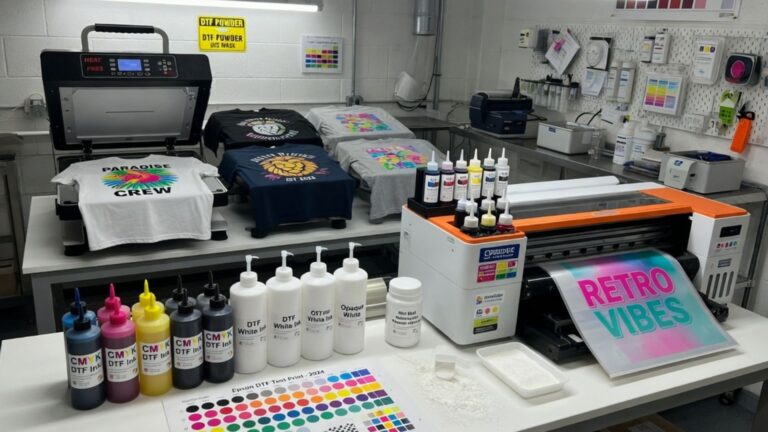
Choosing the best DTF ink is one of the most important decisions for anyone running a direct-to-film printing setup. The ink affects colour vibrancy, white underbase quality, wash durability, printhead performance, film transfer results, and the final feel of the garment. Even with a good printer, premium PET film, reliable adhesive powder, and a properly calibrated heat press, poor-quality ink can lead to dull colours, clogged nozzles, weak adhesion, cracking prints, or inconsistent production results.
DTF printing has become popular because it can transfer designs onto a wide range of fabrics, including cotton, polyester, blends, canvas, denim, and dark garments. However, the process depends on multiple consumables working together. Ink must print smoothly onto film, bond well with hot melt powder, cure correctly, and transfer cleanly under heat and pressure.
This guide explains what makes DTF ink reliable, how to compare options, what to check before buying, and how to maintain ink quality for consistent printing.
What Is the Best DTF Ink?
The best DTF ink is a pigment-based ink designed specifically for direct-to-film printing. It should produce strong colours, stable white ink coverage, smooth printhead flow, good powder adhesion, and durable transfers after heat pressing.
A good DTF ink should offer:
- Bright CMYK colour output
- Stable white ink opacity
- Smooth flow through compatible printheads
- Low clogging risk when used correctly
- Good adhesion with DTF powder
- Reliable transfer from PET film
- Wash-resistant finished prints
- Consistent performance across batches
- Compatibility with the printer and workflow
It is important to use ink made for DTF printing rather than substituting unrelated ink types. Sublimation ink, DTG ink, UV ink, and DTF ink are not interchangeable because they are formulated for different printing processes, surfaces, and curing methods.
Why Best DTF Ink Quality Matters
DTF printing is a layered process. First, the printer lays down colour ink on the film. Then white ink is printed as a backing layer. Adhesive powder is applied to the wet ink, cured, and then transferred to fabric with a heat press. If the ink is unstable, every step after printing can suffer.
Poor ink quality may cause:
- Nozzle clogging
- Banding in prints
- Weak white underbase
- Colour shifting
- Poor powder bonding
- Cracking after washing
- Faded colours
- Inconsistent curing
- Film transfer failures
- More printer maintenance
High-quality ink helps reduce waste and downtime. For print businesses, this matters because failed transfers cost money in film, powder, labour, blank garments, and customer trust.
Best DTF Ink for Epson Printheads
Many DTF printers use Epson-style printheads, including models such as XP600, i1600, and i3200 configurations. Ink compatibility with the printhead is critical. An ink that is too thick, poorly filtered, unstable, or not formulated for the printhead can increase clogging and maintenance problems.
When choosing DTF ink for Epson printheads, consider:
- Manufacturer compatibility guidance
- Recommended printhead models
- Ink viscosity
- Filtration quality
- White ink circulation requirements
- Maintenance routine
- Printer environment
- Shelf life and storage instructions
Do not assume that every DTF ink works well with every printer. Even if the bottle says “DTF ink,” the best results come from matching the ink to the printer, RIP settings, film, powder, and curing process.
Best DTF Ink Color Quality and White Ink Stability
Colour quality is one of the main things buyers notice, but white ink stability is just as important. In DTF printing, white ink acts as a base layer, especially on dark garments. If the white layer is weak, uneven, or clogged, the final design may look dull or patchy.
Good DTF colour ink should provide:
- Clean cyan, magenta, yellow, and black output
- Smooth gradients
- Accurate skin tones
- Strong saturation
- Minimal colour shift after pressing
- Consistent results across batches
Good white DTF ink should provide:
- Strong opacity
- Smooth underbase coverage
- Stable suspension when properly maintained
- Reduced settling when handled correctly
- Clean flow through the printhead
- Good powder adhesion
White ink contains heavier pigment particles, so it needs proper shaking, circulation, and maintenance. A printer with a white ink circulation system may help reduce settling, but regular care is still necessary.
Best DTF Ink Compatibility With Film, Powder, and Heat Pressing
DTF ink does not work alone. It must be compatible with PET transfer film, hot melt adhesive powder, curing equipment, and heat press settings. A good ink may still perform poorly if paired with the wrong film or powder.
Compatibility affects:
- Ink wetting on film
- Powder adhesion
- Curing quality
- Transfer release
- Stretchability
- Wash durability
- Hand feel
- Edge definition
For example, too much ink may cause bleeding or excessive powder buildup. Too little white ink may reduce opacity. Incorrect curing temperature may weaken adhesion. Poor film compatibility may cause incomplete transfer.
For best results, test the full system together rather than judging ink in isolation.
Best DTF Ink for Wash Durability
Wash durability is one of the most important measures of DTF print quality. Customers expect designs to hold up after repeated washing, stretching, and regular wear. Ink quality, powder quality, curing, heat press pressure, and garment fabric all affect durability.
To improve wash performance:
- Use compatible DTF ink and powder
- Cure powder fully but avoid overheating
- Follow correct heat press time and temperature
- Use proper pressure settings
- Allow transfers to cool as recommended
- Test wash results before selling products
- Avoid harsh washing instructions
- Provide garment care guidance to customers
A good DTF ink should support durability, but production settings must also be correct. Many wash failures come from under-curing, poor powder bonding, or incorrect pressing rather than ink alone.
How to Test Best DTF Ink Before Bulk Buying
Before buying large quantities of DTF ink, test it in your actual production environment. This is especially important for print shops producing customer orders.
A practical ink test should include:
- Nozzle check before and after printing
- Colour chart print
- Solid white ink test
- Fine line and small text test
- Gradient test
- Powder adhesion check
- Film release test
- Heat press transfer test
- Stretch test
- Wash test
- Multi-day printer stability check
Testing should be done on the same printer, film, powder, and heat press settings you plan to use for production. This gives a more accurate picture than judging a sample print alone.
Storage and Maintenance Tips for Best DTF Ink
Even high-quality DTF ink can perform poorly if stored or handled incorrectly. Ink stability depends on temperature, shaking, humidity, shelf life, and printer maintenance.
Useful storage and handling tips include:
- Store ink in a cool, stable environment
- Avoid direct sunlight
- Keep bottles sealed when not in use
- Shake white ink as recommended
- Do not use expired ink
- Keep the printer environment controlled
- Perform regular nozzle checks
- Clean printheads according to guidance
- Avoid mixing different ink brands without testing
- Use proper cleaning solution when needed
Many DTF workflows perform best in moderate temperature and humidity conditions. Extremely dry, hot, cold, or dusty environments can affect print consistency and printer health.
Common Mistakes When Choosing DTF Ink
Many beginners focus only on price, but cheap ink can become expensive if it causes waste, downtime, or print failures.
Common mistakes include:
- Buying ink without checking printer compatibility
- Mixing inks from different brands without testing
- Ignoring white ink maintenance
- Using old or poorly stored ink
- Choosing ink only by colour brightness
- Not testing wash durability
- Using incompatible film or powder
- Skipping nozzle checks
- Overlooking curing settings
- Buying bulk ink before trial printing
A reliable ink should support consistent production, not just look good in one sample.
Best DTF Ink Buying Checklist
Before choosing DTF ink, use a checklist to compare options properly.
Check for:
- Printer compatibility
- Printhead compatibility
- CMYK colour strength
- White ink opacity
- Smooth printhead flow
- Low impurity and filtration quality
- Shelf life
- Storage requirements
- Film and powder compatibility
- Wash test performance
- Supplier support
- Batch consistency
- Safety documentation where available
- Clear technical guidance
If you run a business, supplier reliability is also important. You need consistent stock, technical support, and predictable quality from one order to the next.
Conclusion: Best DTF Ink for Reliable Printing Results
The best DTF ink is the one that works consistently with your printer, printhead, PET film, adhesive powder, curing process, and heat press workflow. Strong colour output matters, but so do white ink stability, wash durability, nozzle performance, and production reliability. Before buying in bulk, test the ink under real conditions and review compatibility carefully. With the right ink and proper maintenance, DTF printing can produce vibrant, flexible, and durable transfers for T-shirts, hoodies, bags, denim, canvas, and many other fabric products.
FAQs
What is the best DTF ink?
The best DTF ink is pigment-based ink that offers vibrant colour, stable white opacity, smooth printhead flow, good powder adhesion, and wash durability.
Can I use any ink for DTF printing?
No. DTF printing requires ink formulated for direct-to-film transfers. Sublimation, DTG, and UV inks are not direct substitutes.
Why does white DTF ink clog more often?
White ink contains heavier pigment particles, so it can settle more easily and needs proper shaking, circulation, and maintenance.
How do I know if DTF ink is compatible with my printer?
Check the supplier’s compatibility guidance for your printhead model, printer type, ink system, RIP settings, and maintenance requirements.
Does DTF ink affect wash durability?
Yes, ink quality affects durability, but powder, curing, heat press settings, fabric type, and washing care also matter.
How should DTF ink be stored?
Store DTF ink sealed, away from sunlight, in a stable cool environment, and follow the supplier’s shelf life and handling instructions.


