

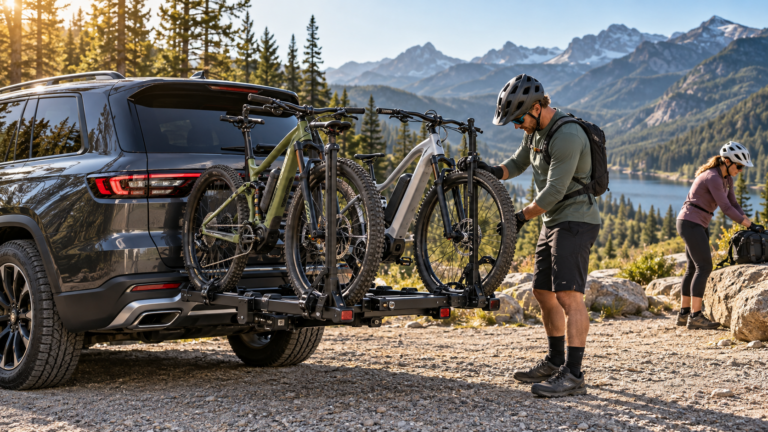
Transporting bicycles should be convenient, secure, and manageable, whether you are planning a weekend mountain biking adventure, visiting a cycling destination, or taking your family on an outdoor holiday. Carrying bicycles inside a vehicle can reduce passenger space, create clutter, and make loading difficult. A hitch bike rack offers a practical alternative by allowing cyclists to transport bicycles outside the vehicle using a compatible trailer hitch receiver. With different mounting styles, weight capacities, and security features available, choosing the right equipment can make regular bicycle transportation considerably easier.
Hitch mounted bicycle carriers are popular among recreational cyclists, mountain biking enthusiasts, road cyclists, and electric bicycle owners. Their rear mounting position generally makes bicycles easier to load than rooftop systems, particularly when the vehicle is tall or the bicycle is heavy.
However, selecting a suitable rack requires careful consideration. Receiver compatibility, bicycle dimensions, vehicle weight limits, rack construction, and installation procedures all affect safe transportation.
This guide explains seven important factors to consider when choosing a bicycle carrier, along with practical advice for installation, loading, maintenance, and long distance travel.
What Is a Hitch Bike Rack and How Does It Work?
A hitch bike rack is a bicycle carrying system designed to attach to the trailer hitch receiver installed at the rear of a compatible vehicle.
The rack typically uses a metal shank that slides into the receiver and is secured using an approved fastening mechanism.
Depending on the design, bicycles are supported by horizontal arms, individual wheel trays, or specialized wheel holding mechanisms.
The carrier allows bicycles to remain outside the passenger compartment while traveling.
Main Components of a Hitch Mounted Bicycle Rack
Although designs vary, many racks contain several important components.
The hitch shank connects the carrier to the vehicle’s receiver.
Support arms or wheel trays provide the primary bicycle mounting points.
Wheel straps, frame clamps, or adjustable hooks help secure each bicycle.
Some models also include locking mechanisms, folding structures, and anti movement systems.
The strength and compatibility of these components determine how the rack can be used.
Why Cyclists Prefer Rear Mounted Bike Carriers
One major advantage is accessibility.
Because bicycles are carried behind the vehicle rather than above it, users generally do not need to lift them onto the roof.
This can be particularly helpful for heavier bicycles.
Rear carriers also leave the roof available for other compatible equipment.
However, they extend the vehicle’s overall length and may interfere with rear doors, parking sensors, lights, or license plate visibility.
Understanding these tradeoffs is important before purchasing.
1. Choose the Right Hitch Bike Rack Design
The first major decision involves selecting a rack style that suits your bicycles and transportation needs.
The two most common configurations are platform racks and hanging racks.
Both can provide dependable transportation when properly matched to the vehicle and bicycle specifications.
Platform Hitch Bike Racks
Platform carriers support bicycles using individual trays or wheel cradles.
Each bicycle is secured through a combination of wheel straps, hooks, or approved frame attachment mechanisms.
This design generally reduces movement between bicycles and may limit unwanted frame contact.
Platform carriers are often suitable for mountain bikes, road bikes, and certain electric bicycles.
Some models accommodate different frame shapes without requiring an additional crossbar adapter.
However, compatibility depends on the individual product.
Advantages of Platform Bike Racks
Platform carriers provide several practical benefits.
- Individual bicycle positioning.
- Convenient loading height.
- Reduced contact between bicycles on many designs.
- Compatibility with various frame shapes.
- Availability of models rated for heavier bicycles.
- Optional loading ramps on selected products.
The main disadvantages can include additional weight, larger storage requirements, and higher purchase costs.
Hanging Hitch Bike Racks
Hanging carriers typically support bicycles using arms that extend from a central upright structure.
Bicycle frames rest on these arms and are held in place by straps or cradles.
This design is often lighter and more compact than comparable platform systems.
Hanging racks may be useful for transporting conventional bicycles with compatible frame shapes.
However, bicycles can sit close together, increasing the possibility of contact during transportation.
Unusual frame geometries may require approved adapters.
Which Rack Type Is Better?
Platform racks are often preferable when transporting expensive bicycles, electric bikes, or different frame designs.
Hanging racks may suit cyclists who prioritize a lighter carrier and lower initial cost.
Neither design is automatically the safest in every situation.
Proper installation, rated capacity, bicycle compatibility, and correct loading remain essential.
2. Check Vehicle Hitch Compatibility Before Purchasing
A bicycle rack must fit the vehicle’s hitch receiver and remain within all applicable load ratings.
Assuming that every carrier works with every hitch can lead to unsafe installations.
Understand Hitch Receiver Sizes
Two common passenger vehicle receiver sizes in the United States are 1.25 inches and 2 inches.
Smaller receivers are often found on certain passenger cars and compact vehicles.
Two inch receivers are common on many SUVs, trucks, and larger vehicles.
However, receiver size should be verified directly rather than inferred from vehicle type.
Some racks are manufactured specifically for one receiver size, while others support multiple sizes through approved configurations.
Does Hitch Size Determine Weight Capacity?
Receiver size alone does not establish the amount of weight a vehicle can safely carry.
The hitch classification, vehicle manufacturer ratings, rack construction, and installation arrangement must also be considered.
Two vehicles with similarly sized receivers may have different load restrictions.
Always consult the vehicle documentation and the hitch manufacturer’s specifications.
Understand Tongue Weight Capacity
Tongue weight capacity describes the maximum permitted vertical load at the hitch connection under the manufacturer’s specified conditions.
When using a bicycle carrier, the combined weight of the rack and all loaded bicycles must be considered.
For example, imagine a rack weighing 35 pounds carrying two bicycles weighing 45 pounds each.
The combined equipment weight would be 125 pounds.
That figure must be evaluated against the vehicle’s approved capacity, the installed hitch rating, and the rack’s specific restrictions.
Because a rack extends outward from the receiver, leverage and dynamic forces can also affect allowable loading. A particular hitch or rack may have additional restrictions that are not captured by a simple weight comparison.
The lowest applicable limit governs the installation.
Check Vehicle Clearance
Receiver compatibility is only one part of a successful fit.
The rack must also provide sufficient clearance around the vehicle’s bumper, spare tire, and rear bodywork.
Vehicles with externally mounted spare tires may require specifically compatible carriers.
Avoid using a hitch extension or adapter unless the manufacturer explicitly approves it for the intended arrangement and load.
3. Match Rack Capacity With Your Bicycles
A rack’s advertised bicycle capacity should never be interpreted without examining the associated weight limits.
A carrier designed for four lightweight bicycles may not be suitable for four heavy electric bikes.
Consider Individual Bicycle Weight
Manufacturers commonly specify a maximum load per bicycle.
This restriction is separate from the number of bicycles the rack can hold.
Each bicycle must remain within its designated position’s rated capacity.
Some expandable carriers have different weight allowances depending on the number of trays installed.
The correct specifications should be checked for the exact rack configuration.
Check Wheelbase and Tire Width
Bicycle dimensions matter as much as weight.
The wheelbase is the distance between the centers of the front and rear wheel axles.
Long mountain bikes and some electric bicycles may require racks with extended wheelbase support.
Fat tire bicycles also need suitable wheel trays and appropriately sized straps.
A carrier that cannot securely accommodate the wheels should not be used.
Consider Frame Materials and Geometry
Bicycle frames are manufactured using materials such as aluminum, steel, carbon fiber, and titanium.
Certain frame designs require specialized mounting arrangements.
For example, some carbon bicycle manufacturers restrict clamping on specific frame sections.
A wheel securing rack may be preferable for these bicycles, provided it is approved for the particular model.
Check Fender and Suspension Compatibility
Full suspension mountain bikes and electric bicycles with fenders can present additional fit challenges.
Some wheel hooks cannot be positioned correctly around certain fenders.
Never force a clamp against a fender or delicate component when the carrier instructions prohibit it.
Choose equipment that securely supports the bicycle without damaging its structure.
4. Prioritize Easy Loading and Everyday Convenience
A bicycle rack should make transportation easier rather than introduce unnecessary complications.
Features that simplify loading, access, and storage can become especially valuable with frequent use.
Look for a Practical Loading Height
One major benefit of rear mounted carriers is their lower loading position compared with roof mounted alternatives.
However, loading height still varies according to vehicle design.
A rack attached to a tall SUV may require more lifting than one installed on a passenger car.
Consider whether every regular user can safely lift the bicycles into position.
For heavier bikes, additional loading equipment may be worthwhile.
Consider a Loading Ramp
Some platform carriers include an integrated ramp or offer a compatible ramp accessory.
A ramp allows users to roll a bicycle onto the carrier instead of lifting its entire weight.
This feature is particularly helpful for heavy electric bicycles.
Check the manufacturer’s instructions for ramp compatibility, loading technique, and weight restrictions.
Choose a Folding or Tilting Rack
Folding racks can reduce the amount of space occupied when bicycles are not being carried.
This may simplify storage and parking.
Tilting designs allow some carriers to move away from the vehicle, creating additional access to the rear cargo area.
However, rear door access varies by vehicle and rack model.
Understand Swing Away Designs
Some carriers include a mechanism that moves the rack outward and to the side.
This can provide more convenient access to the rear hatch.
Swing mechanisms introduce additional components and must be securely locked before driving.
Always verify whether the rack can be moved while loaded and follow the manufacturer’s instructions.
5. Improve Bicycle Security During Transportation
Transporting bicycles involves protecting both the equipment and other road users.
A bicycle that is improperly attached may shift during travel or become detached from the carrier.
Security should therefore be considered before every journey.
Use the Approved Attachment Points
Every bicycle must be secured using the mechanisms specified by the rack manufacturer.
Depending on the design, these may include wheel hooks, frame cradles, ratcheting straps, or other approved restraints.
Do not rely on a single improvised strap when the rack requires multiple securing points.
Check that all components are positioned correctly and that no loose parts can contact the vehicle.
Reduce Unnecessary Movement
Many carriers include an anti rattle mechanism designed to limit movement at the hitch connection.
These systems can improve stability when installed correctly.
However, they do not replace proper hitch attachment or compensate for overloading.
Some movement may occur during driving, but unexpected looseness should be investigated immediately.
Protect Bicycles Against Theft
Some racks include integrated cable locks or locking hitch pins.
These features can help deter opportunistic theft.
Nevertheless, no portable lock should be considered completely theft proof.
Avoid leaving valuable bicycles unattended on a vehicle for prolonged periods.
When staying overnight, secure indoor storage may provide better protection.
Check Lights and License Plate Visibility
Bicycles and carriers can obstruct rear lights, license plates, or vehicle markings.
Requirements vary by location.
Some jurisdictions require an auxiliary lighting system or properly displayed additional registration plate when the original equipment is obscured.
Drivers must comply with applicable local regulations.
6. Choose the Right Carrier for Electric Bikes
Electric bicycles introduce additional transportation considerations because their frames, batteries, motors, and accessories can increase overall weight.
Not every conventional bicycle carrier is suitable for transporting an electric bike.
Select a Suitable Weight Rating
The rack must be approved for the actual bicycle weight.
Some electric bicycles weigh substantially more than conventional models.
Heavy duty platform carriers are often appropriate because they can offer higher individual bicycle capacities and convenient loading systems.
However, the specific weight rating must always be verified.
Check Electric Bike Dimensions
Electric bikes may have longer wheelbases, wider tires, step through frames, or integrated fenders.
These features can affect how securely the bicycle fits the carrier.
Some designs secure the wheels without contacting the frame.
Others require compatible frame attachment points.
The correct choice depends on the bicycle’s construction.
Consider Battery Removal
Some electric bicycle manufacturers recommend or permit removing the battery during transportation.
This can reduce bicycle weight and simplify lifting.
However, battery removal is not universally required or suitable.
Follow the bicycle manufacturer’s instructions for handling, protecting, and transporting its battery.
Protect exposed electrical contacts as directed, and avoid exposing battery components to inappropriate conditions.
Plan for Heavy Bicycle Loading
A loading ramp can help reduce the physical effort required to position a heavy bicycle.
When loading without a ramp, follow the carrier manufacturer’s recommended method.
Never attempt to lift a bicycle that exceeds your safe handling ability.
Assistance from another person may be appropriate.
7. Maintain Your Hitch Bike Rack for Long Term Reliability
Regular maintenance helps keep bicycle carrying equipment in suitable operating condition.
Hitch racks are exposed to road debris, vibration, moisture, and changing weather conditions.
These factors can gradually affect mechanical components and surface finishes.
Inspect the Rack Before Each Trip
Look for loose fasteners, damaged straps, visible cracks, excessive corrosion, and worn securing mechanisms.
Check that the hitch connection is fully engaged.
Confirm that all folding or tilting mechanisms are locked in their required travel positions.
If a component is damaged or cannot be secured correctly, do not use the rack until the problem is resolved.
Clean Road Dirt and Moisture
Road salt, mud, and moisture can accumulate on exposed rack components.
Clean the carrier according to the manufacturer’s maintenance instructions.
Dry appropriate metal surfaces before storage.
Avoid directing high pressure water into bearings, locking mechanisms, or electrical components unless the product instructions permit it.
Store the Rack Properly
When not needed, some carriers can be removed and stored indoors.
A dry storage area can help limit unnecessary exposure to moisture and environmental contaminants.
Folding models may require less storage space.
Protective covers can be useful when recommended by the manufacturer, but they should not trap moisture against the equipment.
Replace Worn Components
Straps, locking parts, and other mechanical components may deteriorate over time.
Use manufacturer approved replacement parts.
Do not attempt structural repairs that could compromise the rack’s load carrying ability.
Hitch Bike Rack vs Roof Bike Rack: Which Is Better?
Hitch mounted and roof mounted bicycle carriers both have advantages.
A hitch carrier usually offers a lower loading position, making it attractive for heavier bicycles and frequent cycling trips.
It also avoids adding bicycles to the vehicle’s roof height.
However, it extends the vehicle’s overall length and can complicate rear hatch access.
A roof rack leaves the rear of the vehicle available but requires lifting bicycles overhead.
Roof mounted equipment also increases total vehicle height, creating additional clearance concerns around parking garages and other low structures.
The better option depends on vehicle compatibility, bicycle weight, loading preferences, and available storage space.
For cyclists frequently transporting heavy electric bicycles, a suitable hitch mounted platform rack is often the more practical choice.
How to Install a Hitch Mounted Bike Rack Correctly
Installation procedures differ between manufacturers, so the product manual should always take priority.
A typical installation begins with inspecting the receiver and confirming that it is clean and undamaged.
The rack shank is then inserted into the hitch receiver to the position specified by the manufacturer.
An approved hitch pin or integrated fastening system secures the carrier.
If the rack includes an anti movement mechanism, tighten it as instructed.
Check the Rack Before Loading
After installation, confirm that the carrier is properly attached.
Inspect all fastening points and verify that the structure is positioned correctly.
Never assume the rack is secure simply because the shank fits inside the receiver.
The correct locking arrangement is essential.
Load Bicycles in the Approved Order
Some manufacturers specify particular loading positions or recommend placing heavier bicycles closer to the vehicle.
Follow those instructions rather than applying a universal loading rule.
Position each bicycle in its designated tray or cradle.
Secure every required contact point before loading additional bicycles.
Perform a Final Safety Inspection
Before driving, confirm that:
- The hitch attachment is secure.
- Every bicycle is within its rated weight limit.
- All required straps and clamps are fastened.
- Wheels and handlebars cannot contact unsafe areas.
- Folding mechanisms are locked.
- Rear visibility and legally required lights remain compliant.
- The carrier does not interfere with the exhaust system.
- No loose accessories can detach during travel.
A short inspection before each journey helps identify problems that may otherwise go unnoticed.
Common Mistakes to Avoid When Buying a Hitch Bike Rack
One frequent mistake is selecting a carrier based only on its advertised bicycle capacity.
The number of supported bicycles does not establish whether the rack can carry their combined weight.
Another mistake is ignoring hitch receiver compatibility.
A carrier may physically fit through an adapter but still be unsuitable for the vehicle or intended load.
Some buyers also overlook bicycle dimensions, especially when transporting fat tire bicycles or long mountain bikes.
Rear clearance is another important consideration.
A rack that obstructs the rear hatch or interferes with an externally mounted spare tire may become inconvenient.
Finally, purchasing solely on price can result in missing features that would make regular transportation easier.
A suitable rack should meet actual transportation needs while staying within every applicable safety limit.
Tips for Long Distance Bicycle Transportation
Long road trips place additional demands on bicycle carrying equipment.
Vibration, changing weather, and repeated stops make preparation particularly important.
Remove loose bicycle accessories when recommended by the rack or bicycle manufacturer.
Check that bags, bottles, and other equipment cannot become detached.
Before beginning the journey, confirm tire straps, wheel hooks, and frame attachments are properly secured.
Adjust Your Driving Awareness
A rear mounted carrier increases the overall length of the vehicle.
Allow additional space when parking, reversing, or maneuvering through tight areas.
Rear sensors and cameras may respond differently when a carrier is installed.
Drivers should not rely exclusively on electronic parking assistance.
Be mindful of uneven roads, steep entrances, and obstacles that could contact a low mounted carrier.
Check Equipment During Stops
At suitable stopping points, inspect the bicycles and rack for movement or loose components.
Recheck attachments according to the manufacturer’s directions.
If unusual movement, noise, or damage appears, stop safely and investigate before continuing.
Consider Weather Exposure
Bicycles transported outside a vehicle can be exposed to rain, road debris, and moisture.
Clean and inspect the bicycles after demanding journeys.
For electric bicycles, follow manufacturer guidance regarding batteries, exposed connections, and wet weather transportation.
Frequently Asked Questions
1. What is a hitch bike rack used for?
A hitch bike rack attaches to a compatible vehicle hitch receiver and carries bicycles outside the vehicle. It helps preserve interior space and simplifies bicycle transportation.
2. Are hitch bike racks suitable for electric bicycles?
Yes, some models are designed for electric bicycles. Check the rack’s individual bicycle weight limit, total capacity, receiver requirements, and dimensional compatibility.
3. What size hitch receiver is needed for a bike rack?
Many bicycle carriers use 1.25 inch or 2 inch receivers. The correct size depends on the specific rack, vehicle, and hitch specifications.
4. Is a platform hitch bike rack better than a hanging rack?
Platform racks often accommodate more frame designs and heavier bicycles, while hanging racks can be lighter and more economical. The best choice depends on compatibility and intended use.
5. Can a hitch bike rack damage a vehicle?
Improper installation, overloading, insufficient clearance, or loose equipment can cause damage. Following manufacturer instructions and relevant weight limits helps reduce these risks.
6. Can you leave a hitch bike rack installed permanently?
Some racks can remain attached when not carrying bicycles, subject to manufacturer guidance and applicable regulations. Regular inspections, weather exposure, and rear vehicle access should be considered.
Conclusion
Choosing the right hitch bike rack can make bicycle transportation more convenient, organized, and secure for everyday rides and outdoor adventures. By understanding receiver compatibility, weight capacity, rack designs, bicycle dimensions, and essential safety features, cyclists can select equipment that suits their vehicles and riding needs. Proper installation, regular maintenance, and careful loading help protect bicycles while reducing avoidable transportation risks. A well matched carrier provides practical support for years of cycling trips and memorable outdoor experiences.
