

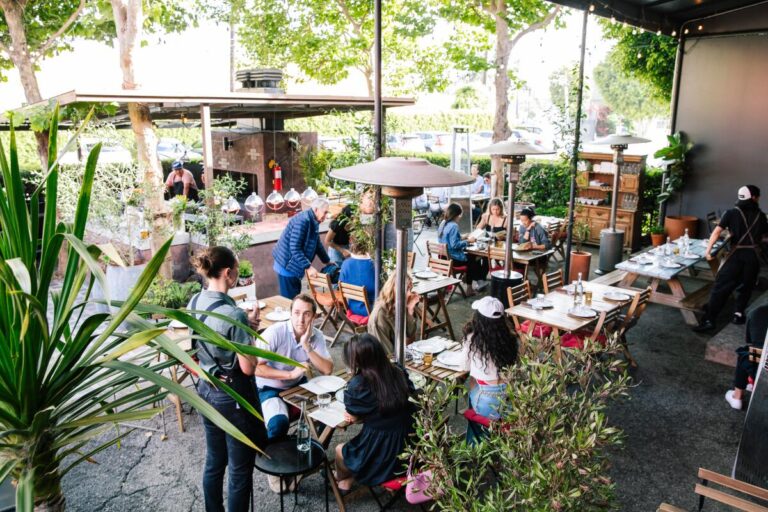
Restaurant marketing runs on a seasonal calendar that has not been updated in a decade. Patio content goes up in spring, terrace photography gets shot in June, and the whole outdoor story carries the summer. Then the weather turns, the terrace furniture goes into storage, and the marketing calendar goes quiet until the holidays.
That gap is a mistake, because guest interest does not go quiet: it moves indoors, and the language it moves into is about enclosure and comfort rather than about weather. Restaurant booths are the physical answer to what people are looking for from November to March, and almost nobody markets them.
Demand Does Not Disappear, It Changes Vocabulary
Start with what actually happens to guest behavior when the season turns.
In summer, people looking for somewhere to eat are looking for outdoor space, and they say so directly. The vocabulary is explicit: patio, terrace, garden, rooftop.
In winter the same intent expresses itself differently. People look for somewhere cozy, somewhere warm, somewhere quiet, somewhere to sit for a while. None of those words names a piece of furniture, and every one of them describes a booth.
The demand did not fall. The query changed, and restaurants that only monitor the explicit terms conclude that interest dropped.
That conclusion then justifies cutting the winter marketing budget, which produces the quiet season the operator was expecting. It is a self-fulfilling read of the data, and it repeats every year.
Seasonality Is Not the Same as Decline
There is a distinction worth being precise about, because it drives the wrong decisions.
Seasonality describes a predictable variation within a repeating cycle rather than a change in the underlying level. Interest in eating out has a seasonal shape. Interest in outdoor seating has a much sharper one, and confusing the two makes winter look worse than it is.
Restaurants that stop marketing in November are responding to a fall in one specific term as though it were a fall in total demand. The rooms doing well in winter are the ones that switched what they were describing rather than how much.
The Word Guests Use Is Not the Word You Use
The second practical problem is a vocabulary mismatch on the restaurant side.
Operators think in terms of booth seating, banquettes and fixed benches, because that is the trade language. Guests do not use any of those words. They search for cozy, for quiet corners, for somewhere private, for a table where you can talk.
A restaurant page that says booth seating available is answering a question nobody asked. A page describing tucked-away corner seating where a conversation actually works is answering the question people are typing, and it is describing exactly the same furniture.
The translation costs nothing. It is the same room, the same photographs and the same seating, written in the words guests use rather than the words a purchase order uses.
The Photography Problem Is the Reverse of Summer
The third issue is visual and it is genuinely harder in winter.
Summer terrace photography is easy. Long daylight, good light, everything looks generous. Winter interior photography is the opposite: short days, artificial light, and a room that has to be shot when it is empty.
Booths solve this better than any other seating. A booth is a large, continuous, high-contrast form that reads at thumbnail size, and an empty booth does not look abandoned the way an empty chair does, because the shape is complete without an occupant. The winter interior shot is the one photograph a booth section is genuinely good at.
What the Sector Data Suggests
It is worth grounding the commercial case rather than asserting it.
The National Restaurant Association’s state of the industry work describes a business running on repeat visits and full checks in an environment with thin margins. Winter is precisely the period when repeat local trade matters most, because there is no visitor traffic carrying the room.
The Census Bureau’s Business Trends and Outlook Survey tracks the operational pressures running through food service across the year, and the pattern is that fixed costs do not follow demand. A quiet January costs almost as much to run as a busy July.
What a Winter Page Should Actually Say
Given all that, the content that works is more specific than a seasonal photograph.
Describe the physical properties rather than the category. How many people a corner seats. Whether a conversation works when the room is full. Whether there is power. Whether the section is warm, which in most buildings means away from the door.
Those are the questions winter guests are actually weighing, and answering them concretely is worth more than any amount of seasonal imagery. A sentence saying the corner booths seat six and sit away from the door does more work than a page of atmosphere.
What to Change Before November
For an operator planning the next winter rather than reacting to it:
- Shoot the interior in October, while there is still usable daylight
- Photograph the booth section occupied, at eye height, not from standing
- Write the copy in guest vocabulary, not trade vocabulary
- Describe warmth, quiet and privacy as physical facts rather than adjectives
- State party sizes each section holds, since group bookings drive winter
- Keep publishing through the quiet months rather than pausing until December
The Season Nobody Competes In
The genuinely useful thing about all of this is that the competition disappears in winter.
Every restaurant in a market fights over the same summer terrace positioning, with the same photographs and largely the same words. From November the field empties, because most operators have accepted that the quiet season is quiet and stopped trying.
The rooms that keep going are competing for the same local trade against almost nobody, describing furniture they already own, using photographs that are easier to take than the summer ones. That is an unusually favorable set of conditions, and it exists every year for five months because the marketing calendar was written around the weather instead of around the guest.


