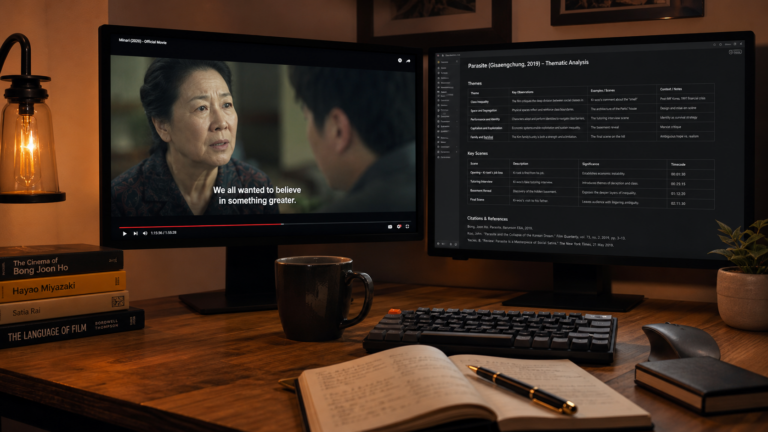
Imagine reaching the final edit of a television review and finding this note: “Great twist somewhere in the middle.” Your streaming subscription ends tomorrow, but you cannot identify the episode, check the dialogue, or explain exactly what made the scene work.
For bloggers, students, and newsletter writers, the solution is not to keep every subscription running indefinitely. It is to separate temporary viewing access from the research notes you need to finish the work. Build a small, searchable log while you watch, then verify the draft before your access ends.
Set a research deadline before choosing access
Start with the writing assignment, not the subscription catalog. Define the question your article will answer and the material needed to answer it. A close reading of one episode needs a different viewing schedule from a comparison of an entire season.
Work backward from the final fact-check, rather than the first draft. In a hypothetical four-week project, you might reserve the first two weeks for viewing, the third for drafting, and the fourth for checking scenes and revisions. This is a planning example, not a claim that a subscription lasts exactly four weeks.
Record the actual activation date, expected end date, renewal conditions, and any cancellation deadline. Check that the required titles, language options, and playback setup are available under the applicable regional and account rules. Leave time for a failed activation or an unexpected rewatch.
For a writer comparing Arabic-language offers, Avndi lists one-month Shahid subscriptions alongside other streaming products. Before scheduling research around an offer, confirm its activation method, account access, duration, and refund or support terms. Treat the listing as the seller’s description: it does not independently establish reseller authorization or equivalence to the provider’s direct subscription. Where an offer provides a viewing profile, do not treat that as an independently owned account or assume you control its recovery settings.
Capture scenes, not just titles
Keep the log in a document or spreadsheet outside the streaming app. Give each useful scene its own entry, with enough detail to locate it again. Record the title, season and episode, platform, viewing date, audio and subtitle languages, and elapsed timestamp. Add a short scene description as a second locator.
Then separate three things: what you observed, what you think it means, and what remains unverified. This makes the log useful for argument as well as recall. Do not transcribe everything; capture the evidence your planned article actually needs.
The following entry is entirely fictional and illustrates the format; it is not a description of a real program or a customer experience.
| Field | Fictional research note |
|---|---|
| Source | Fictional Series A, season 1, episode 2. Record the platform and viewing date with the entry. |
| Version and location | English audio and subtitles; 00:18:20–00:19:05 elapsed from the start; the drawer scene. |
| Observation | A character locks a drawer before answering a colleague’s question. |
| Interpretation | The pause suggests distrust, but the character’s motive is not stated. |
| Next check | Rewatch the earlier conversation before claiming the colleague is suspected of wrongdoing. |
The distinction matters when you draft: “suggests distrust” should not become “confirms betrayal” without additional evidence. Likewise, use quotation marks only for wording you have checked. Label a subtitle quotation as such, and keep a paraphrase separate from exact dialogue.
Use viewing history to find gaps
A viewing-history export can help you reconcile your log with the titles you opened. Netflix’s viewing-history instructions explain how to open Account in a browser, select Profiles, choose a profile, and open Viewing activity. The Download all option exports the list as a CSV file that compatible spreadsheet software can open.
Use that list as a checklist, not as evidence for an interpretation. Compare its entries with your research notes and identify episodes that need attention. Do not treat an entry as proof that you watched every scene carefully, or expect it to explain why a particular sequence matters.
Only access records you are permitted to view. A profile supplied through another account should not be assumed to include access to account-level exports. When an export is unavailable, maintain your own title-and-date log rather than relying on it as a required step.
Keep your notes separate from offline downloads
An offline download is not a permanent research archive. Netflix’s download guidance says downloads expire and that downloads on a device will be deleted if the account is canceled. Do not plan to finish source checks after access ends on the assumption that a downloaded episode will remain available.
Instead, save your own observations, verified wording, source identifiers, and outstanding questions in a file you can open independently of the streaming service. Keep a backup and exclude passwords or redemption codes. Preserve the research record, not extracted video or a workaround for playback restrictions.
Turn the log into a focused draft
Before writing paragraphs, pair each proposed claim with a relevant note. A sentence about pacing might need a sequence of scenes; a sentence about a character’s choice might need one specific exchange. Mark unsupported claims for another viewing session, a narrower formulation, or removal.
For an illustrative 900-word review, you could allocate 100 words to the opening judgment, 150 to essential context, 500 to analysis, and 150 to the conclusion. Those figures are a working budget, not a universal review format. Adjust them to the assignment rather than padding a section to reach its allocation.
Use word counts to check whether plot summary is crowding out analysis. A frequency check can also prompt useful questions: have you repeated “compelling” without describing what earns that judgment, or used “the episode” so often that readers cannot tell which one you mean? Review each occurrence in context rather than replacing words mechanically.
Keep the full evidence log separate from the polished article. Editing a paragraph down should not erase the timestamp, source details, or uncertainty behind it. Retain small note identifiers in the working draft, then convert them into the attribution or citation format your editor requires.
Finish the evidence check before access ends
Reserve the final viewing session for unresolved questions, not for starting another series. Revisit uncertain quotations, character names, episode references, and interpretations that depend on context. For every factual statement drawn from a scene, ask whether you can identify the source and explain what you actually observed.
Then decide whether continued access serves a defined purpose. An unfinished comparison or a planned revision may justify more viewing time. A completed, checked article does not automatically require an active subscription. Follow the applicable renewal or cancellation process and keep any confirmation separately from your research notes.
A log cannot replace every future rewatch. If a later revision raises a question your notes cannot settle, obtain permitted access again or leave the claim unresolved rather than guessing. The useful record is not simply “I watched this.” It is what you observed, where you found it, and which statements you verified before the viewing window closed.