

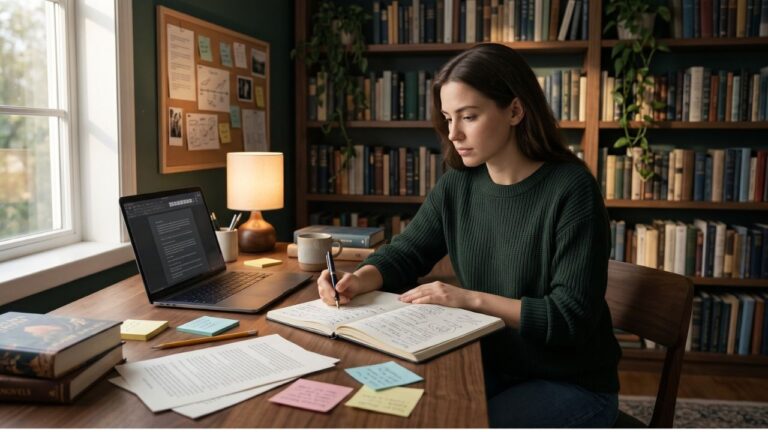
Every writer experiences moments when ideas seem difficult to find. You might sit in front of a blank document, open a fresh notebook, or prepare to begin a new story without knowing what to write. Even experienced authors sometimes struggle to develop interesting characters, original conflicts, and compelling beginnings. Creative Writing Prompts provide a practical starting point by introducing situations, questions, characters, or imaginative scenarios that writers can develop into original work.
A writing prompt does not need to provide an entire plot. Sometimes a single sentence is enough to inspire a short story, poem, fictional conversation, or longer narrative.
For example, imagine finding a letter addressed to you that was written fifty years before you were born. This simple scenario raises immediate questions. Who wrote the letter? How did they know your identity? What information does it contain?
Those questions can lead to mystery, fantasy, science fiction, or emotional literary storytelling.
Writing prompts are also valuable for developing technical skills. They encourage writers to experiment with dialogue, description, point of view, pacing, and character development.
This guide explores 25 original writing prompts across different genres, explains how to use them effectively, and provides exercises for developing stronger storytelling habits.
What Are Creative Writing Prompts?
Creative writing prompts are ideas or instructions designed to inspire original writing.
They can take many forms, including questions, opening sentences, fictional situations, character descriptions, or unusual settings.
A prompt may ask you to imagine a particular event, describe an emotional experience, or write from an unfamiliar perspective.
For example, a prompt might begin with a character discovering that every clock in their town has stopped at exactly the same time.
The writer decides what happens next.
Why Writers Use Prompts
Prompts help reduce the pressure of generating an idea entirely from scratch.
They also encourage experimentation with subjects or genres a writer might not normally choose.
Are Writing Prompts Only for Beginners?
No.
Beginners use them to develop confidence and practice fundamental skills.
Experienced writers use them to explore new techniques, test unusual concepts, or overcome creative stagnation.
Can a Prompt Become a Full Novel?
Yes.
A short exercise can develop into a complex story when the writer introduces meaningful characters, conflicts, and consequences.
Benefits of Using Creative Writing Prompts
Regular writing exercises can support several aspects of creative development.
Encourage Imagination
An unfamiliar scenario encourages writers to consider possibilities outside their everyday experience.
Reduce Writer’s Block
A specific starting point can make the first paragraph less intimidating.
Develop Writing Fluency
Frequent practice helps writers become more comfortable expressing ideas.
Improve Storytelling Skills
Prompts provide opportunities to practice narrative structure and character motivation.
Explore Different Genres
A writer who usually creates realistic fiction may discover an interest in fantasy or mystery.
Build Creative Confidence
Completing short exercises can help writers develop a more consistent writing routine.
Generate Larger Projects
An unexpected exercise may introduce a character or setting worth exploring further.
25 Creative Writing Prompts for Every Type of Writer
The following prompts are organized into five categories, each designed to encourage a different style of storytelling.
You can follow the prompt exactly or modify its details to suit your interests.
5 Short Story Writing Prompts
Short stories are excellent for practicing focused narratives with clear conflicts and satisfying outcomes.
Prompt 1: The Letter From Tomorrow
A character receives a handwritten letter dated exactly one year in the future.
The letter describes three events that have not happened yet.
The first prediction comes true before sunset.
Writing challenge: Create an opening scene that establishes suspense without immediately revealing who wrote the letter.
Consider whether the character should trust the warning or attempt to prevent the remaining predictions.
Prompt 2: The Last Customer
A small bookstore owner prepares to close for the night when an elderly customer arrives.
The visitor asks for a book that the owner has never heard of.
When the owner searches the shelves, the requested book is already there.
Inside its cover is a photograph of the bookstore taken decades before it existed.
Writing challenge: Build a mystery using ordinary details and gradually introduce the unusual element.
Prompt 3: The Wrong Suitcase
Two travelers accidentally exchange identical suitcases at an airport.
One suitcase contains ordinary clothes.
The other contains a notebook describing events from the traveler’s private life.
The final entry describes something that has not yet happened.
Writing challenge: Write the story from the perspective of the person who discovers the notebook.
Explore how the character reacts to information that should be impossible for a stranger to know.
Prompt 4: One Hour of Silence
For exactly sixty minutes, every electronic device in a busy city stops working.
Phones, computers, digital signs, and communications systems become silent.
Most residents panic.
One person appears relieved.
Writing challenge: Tell the story through the actions of three characters whose lives intersect during the outage.
Focus on character choices rather than explaining the technical cause immediately.
Prompt 5: The Forgotten Birthday
A woman wakes up on her birthday and discovers that nobody remembers her existence.
Her photographs remain, but everyone insists the person in them is a stranger.
The only individual who recognizes her is someone she has never met.
Writing challenge: Explore identity, memory, and relationships through a single day.
Decide whether the ending should be mysterious, hopeful, or unsettling.
5 Fantasy and Science Fiction Prompts
Speculative fiction allows writers to develop imaginative worlds and examine familiar human experiences through extraordinary circumstances.
Prompt 6: The City Above the Clouds
A city floats above the clouds, supported by technology that nobody fully understands.
Every hundred years, the city moves to a new location.
This year, it refuses to move.
Writing challenge: Establish the rules of the world and explain how the failure affects ordinary residents.
Focus on one character whose responsibilities suddenly become dangerous.
Prompt 7: The Museum of Lost Memories
In a distant future, people can sell unwanted memories.
A museum collects the most unusual ones.
One day, a curator discovers a memory that appears to belong to every person alive.
Writing challenge: Develop the ethical consequences of treating human memories as property.
Consider how society changes when private experiences can be purchased.
Prompt 8: The Dragon’s Final Request
A kingdom has spent centuries defending itself against dragons.
When the last surviving dragon is discovered, it does not threaten the kingdom.
Instead, it asks a young historian to deliver one message to the royal family.
Writing challenge: Reverse familiar fantasy expectations.
Create tension through hidden history, conflicting loyalties, and difficult choices.
Prompt 9: The Planet That Answers Questions
Explorers discover a planet whose landscape changes whenever someone asks a question aloud.
Simple questions produce small changes.
Complex questions transform entire regions.
A scientist asks whether the planet is alive.
Writing challenge: Build suspense using a fictional scientific discovery with consistent rules.
Consider the consequences of asking a question without understanding its possible answer.
Prompt 10: A Door Between Seasons
A carpenter discovers a door that opens into a different season each time it is unlocked.
Spring leads to a childhood memory.
Winter reveals a future that has not happened.
Autumn opens into a place that should not exist.
Writing challenge: Use seasonal imagery to communicate emotional change.
Develop a meaningful personal decision around the door.
5 Mystery and Suspense Writing Prompts
Mystery prompts encourage careful planning, clue placement, and suspense.
Prompt 11: The Missing Painting
A famous painting disappears from a locked gallery.
Security footage shows nobody entering or leaving the room.
The only unusual detail is that every visitor remembers seeing a different painting.
Writing challenge: Introduce three plausible explanations before revealing the truth.
Ensure that the ending connects logically to clues established earlier.
Prompt 12: The Neighbor Who Never Sleeps
A character notices that the light in a neighboring apartment never turns off.
Every night at exactly 2:17 a.m., a shadow appears at the window.
When the character finally visits the apartment, they discover it has been vacant for years.
Writing challenge: Create suspense through sound, observation, and uncertainty rather than graphic violence.
Prompt 13: The Recorded Confession
A journalist receives an audio recording of a stranger confessing to a crime.
The confession includes accurate details from an unsolved case.
The recording also contains the journalist’s voice asking questions.
But the journalist has never participated in that conversation.
Writing challenge: Develop a mystery involving unreliable evidence and personal uncertainty.
Prompt 14: The Town With No Photographs
A traveler visits a small town where residents refuse to be photographed.
Every photograph taken inside the town appears completely ordinary.
After leaving, however, the people in the images slowly disappear.
Writing challenge: Introduce the strange rule naturally through interactions with local residents.
Prompt 15: The Final Page
A bestselling mystery novelist receives an anonymous manuscript.
It contains a detailed account of the author’s life.
The final chapter describes an event scheduled to happen the next morning.
Several pages have been torn out.
Writing challenge: Build tension using incomplete information.
Decide whether the manuscript describes fate, manipulation, or coincidence.
5 Character Development and Emotional Writing Prompts
Character-focused exercises help writers explore motivation, relationships, and personal transformation.
Prompt 16: The Unsent Apology
A retired teacher discovers a letter written to a former student thirty years earlier.
The letter contains an apology that was never delivered.
The teacher now has one opportunity to make things right.
Writing challenge: Reveal the historical conflict gradually through memory and dialogue.
Avoid making forgiveness automatic.
Prompt 17: The Inherited Garden
Two siblings inherit their grandmother’s abandoned garden.
They disagree about whether to sell the property.
As they restore the garden, they discover small objects connected to forgotten family stories.
Writing challenge: Use the changing garden as a reflection of the siblings’ relationship.
Prompt 18: The Stranger at the Wedding
During a wedding celebration, a guest recognizes someone who is supposed to have died years earlier.
Instead of confronting them, the guest quietly follows them outside.
The stranger claims to have attended every important event in the family’s history.
Writing challenge: Develop the emotional consequences before explaining the mystery.
Prompt 19: The Last Day at Work
A character prepares to leave a workplace after twenty years.
Throughout the day, ordinary conversations reveal how the character influenced people in ways they never realized.
Writing challenge: Create an emotionally meaningful story without relying on a dramatic external event.
Prompt 20: The Promise
Two childhood friends promise to meet at the same bench every ten years.
One friend arrives faithfully.
The other misses two meetings.
At the third reunion, both appear with very different explanations for what happened.
Writing challenge: Explore how time, responsibility, and misunderstanding reshape relationships.
5 Poetry, Journaling, and Experimental Writing Prompts
Not every writing prompt needs a conventional plot.
Some exercises focus on observation, imagery, emotions, or structure.
Prompt 21: A Conversation With the Ocean
Write a poem in which the ocean speaks to someone standing on the shore.
The ocean remembers people and events that the human world has forgotten.
Writing challenge: Use personification without relying on predictable descriptions.
Prompt 22: The Sound of Home
Describe a place that feels like home without naming the location.
Focus entirely on sounds, smells, textures, and small details.
Writing challenge: Avoid directly stating emotions. Allow the sensory descriptions to communicate them.
Prompt 23: A Letter to Your Future Self
Write a letter intended to be opened ten years from today.
Include three hopes, one fear, and a question you do not yet know how to answer.
Writing challenge: Balance honesty with imagination.
You may write as yourself or create a fictional narrator.
Prompt 24: The Object Nobody Notices
Choose an ordinary object, such as a key, cup, notebook, or bus ticket.
Write a first-person account of one extraordinary day from that object’s perspective.
Writing challenge: Establish a distinctive narrative voice while keeping the story understandable.
Prompt 25: The World Without One Word
Imagine a world where one common word has disappeared from every language.
People can understand the concept but cannot express it directly.
Choose a word such as “tomorrow,” “forgive,” or “home.”
Writing challenge: Explore how language influences memory, relationships, and everyday decisions.
How to Turn a Writing Prompt Into a Complete Story
A prompt is only the starting point.
Turning an idea into a satisfying narrative requires development.
Identify the Main Character
Decide whose experience matters most.
A strong character should have motivations, fears, or desires that influence their choices.
Establish the Setting
Determine where and when the story takes place.
Use specific details to create atmosphere.
Introduce a Conflict
A story becomes engaging when something stands between the character and an important goal.
Conflict can be external, internal, or interpersonal.
Raise the Stakes
Explain why the outcome matters.
The consequences should be meaningful to the character.
Create a Turning Point
Introduce a decision, discovery, or event that changes the direction of the story.
Develop the Ending
An ending should reflect the story’s central conflict.
It does not need to resolve every mystery, but it should feel intentional.
Creative Writing Prompts for Beginners
New writers may benefit from short, manageable exercises.
Begin With One Scene
Instead of planning a novel, write a single conversation or event.
Choose Familiar Settings
A school, café, park, or family home can provide an accessible starting point.
Use Simple Goals
Give the main character one clear objective.
Focus on Completion
Finishing a short draft can be more useful than endlessly revising the opening sentence.
Avoid Immediate Editing
Allow the first draft to develop before correcting every word.
Experiment With Different Genres
Trying several forms of writing can help beginners discover their interests.
Review Your Progress
Over time, compare completed exercises to identify improvements.
Advanced Creative Writing Exercises
Experienced writers can use prompts to practice specific techniques.
Write From an Unreliable Perspective
Create a narrator whose account contains mistakes, omissions, or deliberate misdirection.
Limit the Setting
Write an entire story in a single room.
Remove Dialogue
Tell a complete scene through action and observation.
Change the Narrative Voice
Rewrite the same event in first person and third person.
Experiment With Time
Start with the ending and move backward.
Use Symbolism
Give an ordinary object a recurring emotional meaning.
Create Moral Complexity
Write a conflict in which both sides have understandable motivations.
These exercises help develop craft rather than simply produce more words.
How to Overcome Writer’s Block With Prompts
Writer’s block can result from many factors, including uncertainty, perfectionism, fatigue, or difficulty developing an idea.
Reduce the Pressure
Treat the prompt as an experiment rather than a finished publication.
Set a Short Writing Period
Choose a manageable session and write without evaluating every sentence.
Start in the Middle
Begin with an important event instead of forcing yourself to write the perfect introduction.
Change the Perspective
If a scene feels predictable, narrate it through another character.
Ask Questions
Consider what the character wants, what they fear, and what could go wrong.
Modify the Prompt
The original idea does not need to control the entire story.
Take Appropriate Breaks
Creative productivity also depends on rest and attention.
Using Creative Writing Prompts in the Classroom
Writing prompts can support learning across different age groups.
Encourage Participation
A specific scenario gives students something concrete to respond to.
Practice Narrative Structure
Teachers can ask students to write beginnings, conflicts, and endings.
Develop Vocabulary
Descriptive prompts encourage students to use varied language.
Strengthen Communication
Group discussions can help learners explain their ideas.
Support Different Ability Levels
Prompts can be adapted according to student needs.
Encourage Originality
Students should be encouraged to make individual creative choices.
Provide Constructive Feedback
Feedback can focus on clarity, detail, organization, and imaginative development.
Creative Writing Prompts for Daily Journaling
Daily writing does not always require fictional storytelling.
Personal Reflection
Describe a meaningful event from the day.
Observation
Write about something you noticed but normally ignore.
Gratitude
Describe a small experience you appreciated.
Future Goals
Imagine a day in your life five years from now.
Emotional Awareness
Write about an emotion through metaphor or imagery.
Personal Growth
Reflect on something you recently learned.
Imaginative Journaling
Write a diary entry from a fictional character’s perspective.
These exercises can provide variety while encouraging regular writing practice.
How to Create Your Own Writing Prompts
Writers can generate original prompts from ordinary experiences.
Combine Unrelated Ideas
Choose two subjects that rarely appear together.
For example, a lighthouse and a forgotten recipe might inspire a mystery.
Introduce an Unexpected Event
Begin with a normal situation and change one important detail.
Ask What If
Questions create immediate possibilities.
What if nobody could tell a lie for one day?
What if a family discovered that their house appeared on no official map?
Change the Setting
Move an ordinary conflict into an unusual location.
Reverse Expectations
Allow the character expected to be the villain to act heroically.
Use Personal Observations
Conversations, travel experiences, and everyday interactions can inspire fictional situations.
Add a Constraint
Require the story to include a specific object, emotion, or decision.
Constraints can encourage creative problem-solving.
Writing Prompts for Different Fiction Genres
Different genres emphasize different storytelling techniques.
Romance
Focus on relationships, emotional conflict, trust, and meaningful choices.
Mystery
Introduce uncertainty, clues, and a question that drives the narrative.
Fantasy
Build imaginative settings with understandable rules.
Science Fiction
Explore the consequences of hypothetical technologies or scientific developments.
Historical Fiction
Develop stories within carefully researched historical settings.
Horror
Use atmosphere, uncertainty, and emotional tension.
Literary Fiction
Explore character development, relationships, identity, and themes.
A single prompt can often be adapted across several genres.
The Importance of Character Development
Memorable stories depend on believable characters.
Give Characters Goals
A character should want something meaningful.
Introduce Obstacles
Challenges reveal personality and motivation.
Build Personal Histories
Past experiences may influence present decisions.
Include Contradictions
Realistic characters can hold conflicting beliefs or desires.
Develop Relationships
Interactions with other characters create opportunities for change.
Show Growth
A character may learn, fail, adapt, or reconsider their priorities.
Avoid Stereotypes
Thoughtful characterization requires more than assigning familiar personality labels.
Writing Better Dialogue From Prompts
Dialogue can reveal character and move a story forward.
Give Every Speaker a Purpose
Characters should speak because they want to communicate or achieve something.
Use Distinct Voices
Word choice, rhythm, and attitude can help distinguish speakers.
Avoid Excessive Explanation
Characters do not need to describe information everyone in the conversation already knows.
Include Subtext
Sometimes the most important meaning is what a character avoids saying.
Use Action Alongside Speech
Small movements and reactions can make conversations feel natural.
Read Dialogue Aloud
Listening can reveal awkward sentences.
Keep Conversations Relevant
Dialogue should contribute to character, atmosphere, or conflict.
How to Build a Consistent Writing Habit
Writing regularly can support creative growth.
Set Realistic Goals
Choose a sustainable daily or weekly target.
Create a Writing Space
Find an environment that supports concentration.
Maintain an Idea List
Record interesting situations whenever they occur.
Use Short Prompts
Brief exercises can make writing easier to begin.
Track Completed Work
Reviewing finished drafts can demonstrate progress.
Separate Drafting and Editing
Allow ideas to develop before polishing them.
Accept Imperfect First Drafts
Revision is a normal part of the creative process.
Common Creative Writing Mistakes to Avoid
Several habits can make writing less effective.
Overexplaining the Plot
Give readers enough information to understand the story without removing every opportunity for discovery.
Weak Character Motivation
Important decisions should connect to recognizable desires or fears.
Excessive Description
Details should contribute to atmosphere, characterization, or understanding.
Predictable Conflicts
Consider how a familiar situation might develop unexpectedly.
Unrealistic Dialogue
Avoid making every character speak in the same style.
Ignoring Revision
A first draft often requires structural and sentence-level improvements.
Copying Prompt Responses
Prompts are starting points for original writing, not a reason to reproduce another author’s work.
Using AI to Generate Creative Writing Prompts
AI tools can help writers brainstorm situations, characters, and story structures.
Generate Multiple Ideas
An AI assistant can suggest different premises around a chosen subject.
Explore Genres
Writers can request mystery, romance, fantasy, or science fiction variations.
Develop Characters
AI can suggest motivations, conflicts, and possible backgrounds.
Create Writing Exercises
Users can request prompts focused on dialogue, imagery, or narrative structure.
Evaluate Plot Possibilities
AI can help explore alternative directions for a story.
Maintain Originality
Writers should make their own creative decisions and review generated material carefully.
Understand Limitations
AI-generated prompts may contain clichés, repetitive structures, or inconsistent ideas.
Human imagination remains essential to developing meaningful original work.
A Seven-Day Creative Writing Challenge
A short challenge can help writers establish momentum.
Day 1: Write a Mysterious Beginning
Choose a prompt involving an unexpected discovery.
Focus on the first 300 words.
Day 2: Build a Character
Write a scene that reveals a character’s motivation without directly explaining it.
Day 3: Practice Dialogue
Create a conversation in which the speakers disagree but avoid stating the real issue.
Day 4: Describe a Setting
Use sensory details to establish atmosphere.
Day 5: Introduce Conflict
Write a scene where a character must make a difficult decision.
Day 6: Create an Ending
Choose one earlier exercise and write a meaningful conclusion.
Day 7: Revise and Reflect
Review the completed work.
Identify one strength and one area for improvement.
This routine can be repeated with different prompts.
How to Evaluate Your Creative Writing Progress
Improvement is easier to recognize when writers reflect on completed work.
Story Clarity
Can a reader understand the central situation?
Character Motivation
Are the character’s choices believable within the story?
Narrative Structure
Does the writing move through meaningful developments?
Descriptive Detail
Do descriptions help create a clear experience?
Dialogue
Does conversation reveal character and contribute to the narrative?
Originality
Does the work offer a distinctive perspective?
Revision Quality
Have unnecessary sentences and confusing passages been improved?
Writing progress is not measured only by word count.
The development of stronger decisions and more effective storytelling matters too.
Conclusion
Creative Writing Prompts offer an accessible way to develop imagination, improve storytelling skills, and overcome the uncertainty of beginning a new piece of writing. From mystery and fantasy to emotional fiction, poetry, and journaling, prompts encourage writers to explore unfamiliar ideas and experiment with different narrative techniques. The 25 original exercises in this guide can be adapted into short stories, longer fiction, classroom assignments, or daily creative practice. The greatest value comes from using prompts consistently, developing characters and conflicts thoughtfully, and revising completed drafts. With curiosity, regular practice, and a willingness to experiment, writers can turn simple ideas into distinctive and memorable stories.


