

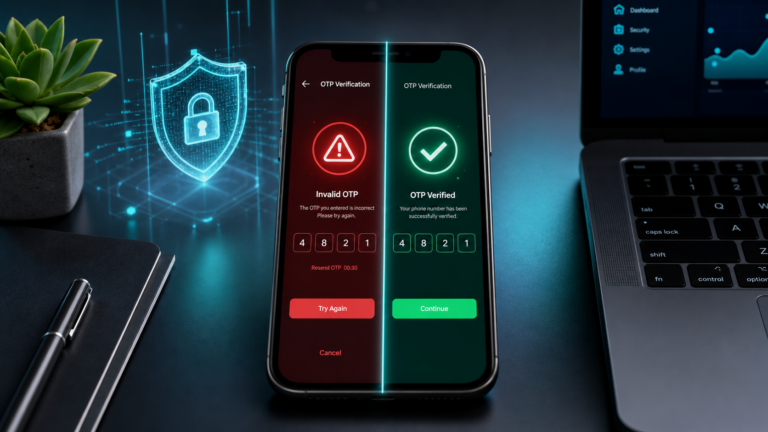
For a website or digital product, registration is often treated as a simple sequence: collect a mobile number, send a one-time password, verify it, and create the account.
In practice, that small sequence can become one of the most fragile parts of the user journey.
A visitor may enter a phone number in the wrong format. The verification message may arrive after the user has already pressed “resend.” A second code can invalidate the first without the interface explaining what happened. An automated script may repeatedly trigger SMS requests. Or the backend may successfully deliver a code while the product team records the event merely as “registration failed.”
For teams building Saudi-facing websites and applications, a better approach is to treat mobile-number verification as a product flow with three separate concerns: user experience, message delivery, and verification security.
The OTP Screen Is Not the Whole Verification Flow
An OTP, or one-time password, is a temporary code used to confirm that a user has access to a particular phone number or authentication factor.
From the user’s perspective, the process looks short:
- Enter a mobile number.
- Receive a code.
- Enter the code.
- Continue.
From the application’s perspective, considerably more is happening.
The system has to validate the number, create a verification attempt, request delivery, track the attempt, accept the submitted code, reject incorrect or expired codes, control retries, and decide what happens after successful verification.
This distinction matters because teams frequently optimize the visible OTP input while ignoring what happens before and after it.
A polished six-digit input field cannot compensate for a backend that allows unlimited requests or gives users no useful recovery path when a message does not arrive.
Start With the Phone-Number Field
For Saudi products, phone-number formatting is an easy place to create unnecessary friction.
A Saudi user may naturally type a number beginning with 05, while another may enter the international +9665 format. The product should decide which formats it accepts and normalize them consistently before verification.
Do not make the user solve a formatting problem that the application can safely handle itself.
A useful mobile-number form should make the expected country clear, detect obviously invalid input before requesting an OTP, and avoid destroying what the user typed simply because validation failed.
The backend should still perform its own validation. Client-side validation improves the experience; it is not a security boundary.
Separate “Send” From “Verify”
One of the cleanest ways to reason about an OTP implementation is to divide it into two backend actions.
Action 1: Start the Verification
The server receives the phone number and asks the verification provider to initiate a verification attempt.
The application should retain an identifier for that specific attempt rather than treating every code sent to the same number as interchangeable.
Action 2: Check the Verification
When the user enters the received code, the application sends the code together with the verification-attempt identifier for validation.
Only after verification succeeds should the application perform the intended action: creating an authenticated session, confirming the phone number, completing registration, or approving another protected operation.
This separation also makes integration easier to observe. A team can distinguish between:
- requests that never reached the verification service,
- delivery problems,
- incorrect codes,
- expired attempts,
- excessive attempts,
- and successful verification.
For a Saudi-focused implementation, Tawked is one example of a service built around API-based OTP delivery to Saudi mobile numbers, with reviewed sender names. Its role belongs at the delivery and verification layer; the application itself should still control its registration rules, session creation, abuse controls, and overall user experience.
Do Not Turn the Resend Button Into an SMS Generator
“Resend code” looks harmless because it is a small interface element.
Technically, it exposes an action that may cause an external message to be sent every time it is triggered. Without controls, automated scripts can repeatedly invoke it.
That creates both operational and security problems.
A sensible resend design combines several layers of protection rather than relying on a single IP-address limit. OWASP’s anti-automation guidance recommends applying rate limits using multiple signals because IP-only protection can be bypassed by distributed traffic.
Possible controls include limits associated with the destination phone number, session, endpoint, account when one exists, and network source.
The interface should support those controls rather than fight them. After sending a code, temporarily disable the resend action and clearly tell the user when another request becomes available.
Most importantly, decide what a resend actually means.
If a new request generates a new code, establish whether the previous code becomes invalid. Otherwise a user who receives messages out of order may enter an older code and assume the product is malfunctioning.
Expiry Is Necessary, but It Is Not Enough
An OTP should not remain valid indefinitely.
OWASP recommends that OTP implementations use a short time-to-live, make codes single-use, enforce attempt limits, invalidate them after successful verification, and avoid logging the actual OTP value.
Those recommendations address several different problems.
Expiration reduces the period during which a captured code is useful. Single-use behavior prevents a successfully submitted code from being replayed. Attempt limits make repeated guessing harder. Avoiding OTP values in logs reduces accidental exposure through debugging tools, analytics systems, or operational dashboards.
These protections should work together.
A short-lived code with unlimited verification attempts is a weak design. An attempt limit with a code that remains reusable after success is also incomplete.
Treat an OTP as Proof of Access, Not Proof of Identity
A successful SMS verification establishes a narrow fact: the verification process was completed using access to the destination number at that time.
Teams should resist turning that fact into a broader security claim.
SMS-based codes have known limitations, including risks involving phone-number takeover and interception. OWASP specifically discusses these limitations and recommends stronger, phishing-resistant authentication approaches for applications requiring higher assurance.
The appropriate architecture therefore depends on what is being protected.
Verifying a phone number while creating an ordinary account is not the same risk problem as authorizing a high-value financial action or changing a critical account credential.
A product can use SMS OTP effectively within its threat model without pretending that OTP alone solves account security.
For sensitive actions, additional controls may include reauthentication, device or session risk checks, additional authentication factors, fraud detection, or phishing-resistant authentication methods.
Transactional Verification Is Different From Marketing SMS
Product teams should also keep authentication traffic conceptually separate from promotional messaging.
An OTP is a transactional message. It exists because the user initiated a specific action, such as registration, login, phone-number confirmation, or account recovery.
A marketing message exists to promote, advertise, or re-engage.
Mixing those purposes creates architectural and operational confusion. Verification infrastructure should be optimized around requested authentication events rather than being treated as another channel for bulk campaigns.
That separation also makes monitoring more meaningful. A sudden increase in OTP requests may indicate a registration campaign performing well—or it may indicate automated abuse. If verification traffic is mixed with unrelated messaging, that signal becomes harder to interpret.
Monitor the Funnel, Not Just SMS Delivery
A verification provider can tell you something about message processing and delivery. It cannot tell you whether your registration experience is successful.
Product analytics should therefore follow the entire verification funnel.
A useful model is:
phone number submitted → verification requested → message delivered → code submitted → verification accepted → registration completed
Each transition answers a different question.
If many people submit numbers but few requests are successfully created, investigate the integration or input validation.
If requests are created but users rarely submit codes, investigate delivery, UI instructions, number formatting, or abandonment.
If codes are frequently submitted but rejected, examine expiry behavior, resend logic, attempts from old messages, and input problems.
If verification succeeds but registration completion remains low, the OTP system may not be the problem at all. Something later in onboarding may be causing users to leave.
This is why “SMS delivery rate” and “registration conversion rate” should never be treated as synonyms.
Design Failure States Before Launch
Teams tend to design the successful path first:
Enter number → receive code → verify → welcome.
The more revealing design exercise is to document every meaningful failure path before shipping.
Ask what the user sees when:
- the phone number is malformed;
- the verification request is rate-limited;
- delivery fails;
- the message is delayed;
- the user enters the wrong code;
- the code expires;
- the user requests another code;
- the old message arrives after the new one;
- the verification provider is temporarily unavailable;
- or verification succeeds but account creation fails afterward.
Each state needs both a backend decision and understandable interface copy.
Avoid generic messages such as “Something went wrong” where the user can safely be given a more useful next action. At the same time, authentication error responses should not disclose information that unnecessarily helps an attacker.
Keep Verification State on the Server
OTP integrations should be handled through trusted server-side code.
Secret API credentials should not be embedded in browser JavaScript or shipped inside client applications where they can be extracted and abused.
The browser can collect the phone number and code, but your backend should communicate with the verification service and decide what application state changes after successful verification.
The same principle applies to logging.
Operational logs can contain useful information such as attempt IDs, timestamps, delivery states, and normalized error categories without recording the OTP itself. OWASP recommends treating OTPs as authentication secrets and specifically advises against logging their values.
A Pre-Launch OTP Review
Before releasing a registration flow based on mobile verification, a product and engineering team should be able to answer the following questions:
- Which Saudi phone-number formats do we accept?
- How are numbers normalized on the server?
- What creates a verification attempt?
- How is that attempt associated with the user’s session?
- How long does an attempt remain valid?
- What happens when a user requests another code?
- How many failed verification attempts are permitted before additional action is required?
- Which controls prevent repeated message requests?
- Are OTP values excluded from application logs and analytics?
- What does the interface show when delivery is delayed or fails?
- What happens after successful verification?
- Which events are recorded for funnel analysis?
- Do sensitive account actions require stronger controls than simple phone possession?
- Can the team distinguish delivery failure from user abandonment?
If several answers are unclear, changing SMS providers is unlikely to solve the underlying problem.
The more useful next step is to draw the complete verification flow—from the first phone-number submission to the final authenticated session—and label every state, retry, security control, and measurable event. That exercise usually reveals weaknesses long before users encounter them.


