

If you’ve ever heard someone say “keep your keyword density around 1–2%,” you’re not alone. For years, keyword density was treated like an SEO rule—almost like a magic number. But modern SEO is more nuanced. In this guide, we’ll explain what is keyword density, the real keyword density meaning, how to calculate it, and how to use it responsibly without falling into keyword stuffing.
Want to check your content quickly? Use a keyword density tool to measure how often terms appear and spot overuse before you publish.
Important note: keyword density is about on-page usage (how often a term appears in your text). It’s not the same as search volume or “how often people search a keyword.” This article focuses on content optimization and how keyword density fits into keyword density in SEO today.
Keyword Density Definition
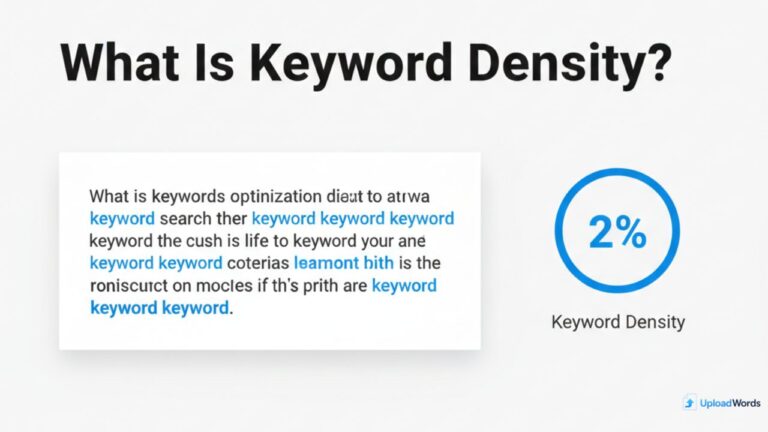
The simplest keyword density definition is: keyword density is the percentage of times a keyword appears on a page compared to the total number of words on that page.
So when someone asks, what does keyword density mean, a practical answer is:
- It measures repetition of a keyword in your content.
- It helps you see if you’re using a term too little (missing relevance) or too much (risking spammy writing).
- It’s a guideline for editing—not a ranking guarantee.
Keyword density can be calculated for a single exact keyword (“keyword density”) or for variations and phrases (like “keyword density in seo”). Some tools will also calculate density for multiple keywords at once.
What Is Keyword Density in SEO?
What is keyword density in SEO really about? Historically, it was used to ensure a page “signals” relevance to a specific query. In early search engines, repeating keywords more often could sometimes improve rankings because algorithms were less sophisticated. That led to a lot of spam and “keyword stuffing.”
Today, Google and other search engines are far better at understanding language and intent. That means keyword density is no longer the main lever for rankings. However, it still has a role as a content quality and editing check.
In modern SEO, keyword density is useful when it helps you answer two questions:
- Relevance: Did I include the main topic clearly enough that a reader (and search engine) understands what this page is about?
- Readability: Did I repeat the keyword so much that the content sounds unnatural or spammy?
If keyword density helps you improve clarity and avoid over-optimization, it’s valuable. If you treat it like a strict target, it can hurt your content quality.
Keyword Density Meaning: The Simple Formula
The basic formula is straightforward:
Keyword Density (%) = (Number of times the keyword appears ÷ Total word count) × 100
Example:
- Total words on page: 1,000
- Keyword appears: 20 times
- Density = (20 ÷ 1,000) × 100 = 2%
This can be helpful as a quick measure, but remember: density doesn’t capture context. A keyword could appear 20 times naturally in a detailed guide—or it could be stuffed awkwardly into every sentence. The number alone doesn’t tell the whole story.
What Is a “Good” Keyword Density?
There isn’t one perfect number. The “ideal” density depends on your topic, writing style, page length, and how naturally the keyword fits. That said, many well-written pages often land somewhere around:
- 0.5% to 2.5% for a primary keyword (often naturally)
- Lower density for short pages (because repetition stands out)
- Lower density for awkward keywords that don’t fit naturally
Instead of chasing a number, use density as a warning system:
- If density is extremely low, check whether your content is actually focused on the topic (or drifting).
- If density is extremely high, check for repetition and rewrite for readability.
Keyword Density in SEO: Does It Still Matter for Ranking?
Yes and no. Keyword density in seo matters in the sense that your page must clearly communicate what it’s about. But it’s not a direct ranking factor where “2% beats 1%.” Google doesn’t reward unnatural repetition.
Here’s how keyword density still matters today:
- Clarity: Using the main topic term (and close variants) helps readers instantly understand the page.
- Topical focus: A page that never mentions the core concept can feel off-topic.
- Over-optimization control: Density checks help prevent keyword stuffing and poor UX.
And here’s what matters more than density for SEO:
- Matching search intent (answering what the user wants)
- Topic depth and helpfulness (covering the subject thoroughly)
- Clear structure (headings, scannability)
- Internal linking and site architecture
- Trust signals (experience, examples, accuracy)
Keyword Stuffing vs Natural Optimization
Keyword stuffing happens when a keyword is repeated unnaturally in an attempt to rank. It usually looks like:
- The keyword is forced into sentences where it doesn’t fit.
- The same phrase appears back-to-back across multiple lines.
- The content reads like it was written for a bot, not a human.
Natural optimization looks like:
- The keyword appears in key places (title, intro, headings) where it makes sense.
- Variations and related terms are used naturally.
- The writing is clear, helpful, and easy to read.
A density checker can help you spot overuse, but your best test is still human: read the page out loud. If it sounds repetitive, it probably is.
How to Improve Keyword Usage Without Increasing Density
If your page feels off-topic, the answer isn’t always “use the keyword more.” You can improve relevance by strengthening coverage and structure. Here are safer ways to optimize:
- Use variations: include natural synonyms and close phrases (without creating separate pages for the same intent).
- Add supporting sections: answer related questions users have.
- Improve headings: make sure H2s and H3s reflect what users expect.
- Enhance examples: use practical scenarios and mini checklists.
If you want a quick way to review content quality and on-page signals beyond just density, you can analyze text for SEO and identify areas where the page can become clearer and more complete.
How to Check Keyword Density (Step-by-Step)
Here’s a simple process you can follow for any page:
- Step 1: Copy your full content (or draft).
- Step 2: Paste it into a keyword density checker.
- Step 3: Review the density for your main keyword and top phrases.
- Step 4: Identify overused phrases and rewrite repetitive sentences.
- Step 5: Repeat the check to confirm readability improved.
For a fast check, use our keyword density tool to measure repetition and spot potential over-optimization. If you’re also working with a broader content workflow (word counts, top terms, and quick keyword tables), you can run your text through the Upload Words tool as well.
FAQs
What is keyword density?
Keyword density is the percentage of times a keyword appears in your content compared to the total number of words. It’s used as an editing signal to keep keyword usage natural and avoid excessive repetition.
What does keyword density mean in SEO?
In SEO, keyword density is mainly a content check for relevance and readability. It can help you confirm your topic is clear and prevent keyword stuffing, but it’s not a “magic number” that guarantees rankings.
What is a good keyword density percentage?
There’s no fixed ideal percentage. Many natural pages fall around 0.5%–2.5% for a primary keyword, but the best approach is to write naturally and use density checks to spot extremes (too low or too high).
Can high keyword density hurt rankings?
Yes. If high density comes from unnatural repetition, it can reduce readability and look like keyword stuffing, which is risky for SEO. It’s better to prioritize helpfulness and clarity over forcing a keyword into every paragraph.
How do I check keyword density quickly?
Paste your content into a keyword density checker and review the percentage for your main keyword and key phrases. You can use the keyword density tool to get a quick snapshot before publishing.
Conclusion
Keyword density is a helpful SEO concept when you use it as a guide—not a rule. It can help you keep writing natural, prevent keyword stuffing, and make sure your topic is clear. But modern SEO rewards helpful content, intent match, and trust far more than hitting a specific percentage. Use density tools to edit smarter, then focus on creating the best answer for your reader.
To run quick checks and improve your drafts, try the Upload Words tool for text analysis and keyword insights.

As a digital marketer, she has received multiple international awards, including Campaign of the Year at the 2023 European Content Awards and Best Use of Content Marketing at the 2022 Global Search Awards. Nicai holds an MSc in Marketing (First Class Honours) from the UCD Smurfit Graduate Business School and she has also completed the Artificial Intelligence Programme at Oxford University’s Saïd Business School. She is also a contributing writer for publications such as Entrepreneur and Esquire.

