

Keyword density is one of those SEO concepts that sounds technical but is actually very simple once you see the math. If you’re editing a blog post, landing page, or product description, knowing the keyword density formula helps you measure how often a keyword appears and whether the content reads naturally. In this guide, you’ll learn how to calculate keyword density, how to interpret keyword density percentage correctly, and how to avoid the biggest mistakes (like keyword stuffing or obsessing over a “perfect” number).
If you want to skip manual math, start with a keyword density calculator to instantly see keyword density percent and top phrases for your content.
Important: keyword density is a content editing signal—not a ranking guarantee. Modern SEO is more about intent match, helpfulness, and clarity. But measuring keyword density can still help you spot overuse, repetition, and unnatural phrasing before you publish.
What Is Keyword Density?
Keyword density is the percentage of times a keyword appears in a piece of text compared to the total number of words. It’s a quick way to quantify repetition. For example, if your article is 1,000 words and your target keyword appears 20 times, your keyword density is 2%.
People use keyword density to answer practical questions like:
- Am I using the keyword too often (risking keyword stuffing)?
- Am I barely mentioning it (making the page feel off-topic)?
- Are there repeated phrases I should rewrite for readability?
As long as you treat density as a “health check” instead of a strict target, it can be useful.
Keyword Density Formula (The Correct Formula)
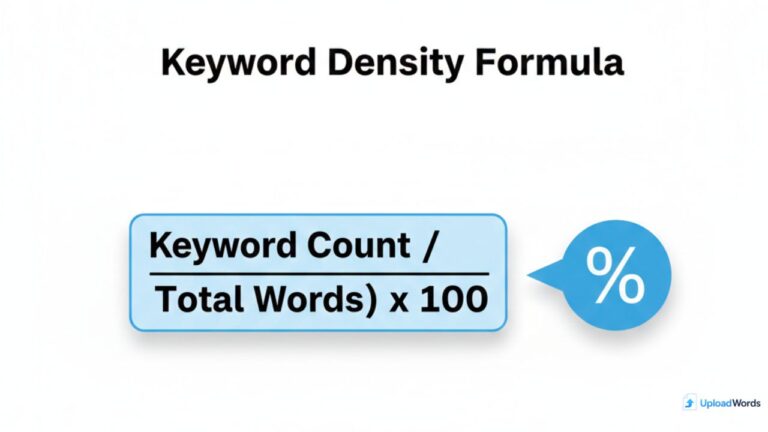
The standard keyword density formula is:
(Keyword Count ÷ Total Word Count) × 100 = Keyword Density (%)
This gives you the keyword density percentage. Some people call it keyword density percent—it means the same thing.
Example calculation
- Total words: 1,500
- Keyword appears: 15 times
- Density = (15 ÷ 1,500) × 100 = 1%
That’s the basic keyword density calculation. The key is counting the keyword accurately and using the correct total word count.
How to Calculate Keyword Density Step-by-Step
If you want to do it manually (or understand what tools are doing behind the scenes), follow these steps:
Step 1: Pick the exact keyword or phrase
Decide what you’re measuring. For example:
- Single-word keyword: “density”
- Multi-word phrase: “keyword density formula”
- Close variation: “how to calculate keyword density”
Be consistent. If you’re measuring a phrase, count exact phrase matches, not partial matches—unless your tool is designed to group variations.
Step 2: Count how many times it appears (keyword count)
Count exact matches in your text. Most editors have a “find” feature you can use. For phrase keywords, make sure punctuation and capitalization don’t throw off your counting.
Step 3: Count total words in the content
Use a word counter (or a tool) to get the total word count. This is the denominator in the formula.
Step 4: Apply the formula
Use:
Keyword Density (%) = (Keyword Count ÷ Total Words) × 100
This tells you the density as a percentage—your keyword density ratio expressed in percent form.
Step 5: Interpret the result (don’t chase a “perfect number”)
Numbers help, but they don’t replace common sense. A keyword repeated naturally inside a detailed tutorial may have a higher density and still read well. Meanwhile, a short sales page can feel spammy with even moderate repetition.
Keyword Density Percentage: What Is a “Good” Range?
There is no universal “best” keyword density percentage. Many well-written pages naturally fall around 0.5% to 2.5% for the primary keyword, but that varies widely by topic and writing style.
Instead of a fixed target, use density like a warning light:
- Very low density: your page may not clearly focus on the topic.
- Very high density: your page may feel repetitive or stuffed.
A better question than “What percent should I hit?” is: “Does the page read naturally and clearly explain the topic?” Density tools help you confirm that.
Measuring Keyword Density: Single Words vs Phrases vs Variations
Measuring keyword density gets tricky when you mix single words, phrases, and variations. Here’s how to think about it:
Single-word density
Single words appear in many contexts and can inflate density. For example, “tool” or “SEO” might repeat naturally without being your focus keyword. Single-word density is useful for spotting overuse but can be misleading for relevance.
Phrase density (recommended for primary targets)
Phrase density is often more meaningful for SEO because it measures exact intent-focused phrases like “keyword density formula.” This can be a cleaner signal than counting a single word that appears in unrelated places.
Variation grouping
Some tools group variations together (like “keyword density meaning,” “keyword density definition,” and “what does keyword density mean”). That can be helpful for topic coverage, but it’s important to know whether your tool is counting exact matches or grouped matches.
If you want a quick, practical view of your text, using a tool is usually easier than manual counting—especially for phrases and multiple keywords.
For quick checks and term insights beyond just density, you can also use the keyword density tool workflow inside UploadWords to paste text, get word counts, and see top terms instantly.
Common Keyword Density Calculation Mistakes
1) Counting wrong (partial matches vs exact matches)
If your keyword is a phrase, decide whether you want exact phrase matches only or whether partial matches count. For example, if the target phrase is “keyword density formula,” does “formula for keyword density” count? Some tools treat these differently.
2) Forgetting headings and UI text
If you copy content from a page, you might unintentionally include menu items, sidebar text, or repeated headings. That can distort the total word count and keyword count. Tools that analyze pasted “clean text” can reduce this problem.
3) Obsessing over a percentage instead of readability
SEO isn’t a math contest. If you rewrite sentences to hit an exact percentage, you often make the content worse. Use numbers to catch extremes—then rewrite for clarity, not for a target ratio.
Keyword Density Ratio vs Keyword Density Percentage
You may hear both “ratio” and “percentage.” They describe the same relationship:
- Ratio: keyword count ÷ total words (e.g., 0.02)
- Percentage: ratio × 100 (e.g., 2%)
Most SEO tools show the percentage because it’s easier to read. But if you see a decimal value, it’s just the same keyword density expressed differently.
FAQs
How do you calculate keyword density?
Use the keyword density formula: (keyword count ÷ total word count) × 100. This gives you keyword density as a percentage.
What is the keyword density formula?
The keyword density formula is: (Keyword Count ÷ Total Words) × 100. It measures how often a keyword appears compared to the overall length of the text.
What is a good keyword density percentage?
There’s no fixed ideal number. Many natural pages fall around 0.5%–2.5% for a primary keyword, but it depends on the topic and writing style. Focus on readability and use density tools to spot extremes.
Is keyword density still important for SEO?
Keyword density matters mainly as a content editing check. It can help you avoid keyword stuffing and ensure topic clarity, but modern SEO depends more on intent match, helpfulness, and overall content quality.
How can I measure keyword density quickly?
The fastest way is to paste your content into a keyword density checker. A keyword density calculator can instantly show percentages for your main keyword and top phrases without manual counting.
Conclusion
The keyword density formula is simple, but the smartest way to use it is also simple: treat keyword density as a guide, not a rule. Use it to catch repetition, improve readability, and confirm topic focus—then prioritize writing the best possible answer for your reader.
If you want a fast check, try a keyword density calculator. And for broader text insights and quick keyword tables, paste your content into the UploadWords tool for analysis.
For more help using the tools, visit the UploadWords FAQs.
Quick Tools & Next Steps
Use these pages to speed up your keyword workflow:
- Keyword density calculator — measure keyword density percentage instantly.
- Upload Words tool — paste text and review top terms and keyword usage.
- UploadWords FAQs — answers about results and tool features.
Tip: Run a density check after your final edit. If the content sounds repetitive, rewrite for clarity—not for a number.

As a digital marketer, she has received multiple international awards, including Campaign of the Year at the 2023 European Content Awards and Best Use of Content Marketing at the 2022 Global Search Awards. Nicai holds an MSc in Marketing (First Class Honours) from the UCD Smurfit Graduate Business School and she has also completed the Artificial Intelligence Programme at Oxford University’s Saïd Business School. She is also a contributing writer for publications such as Entrepreneur and Esquire.

