

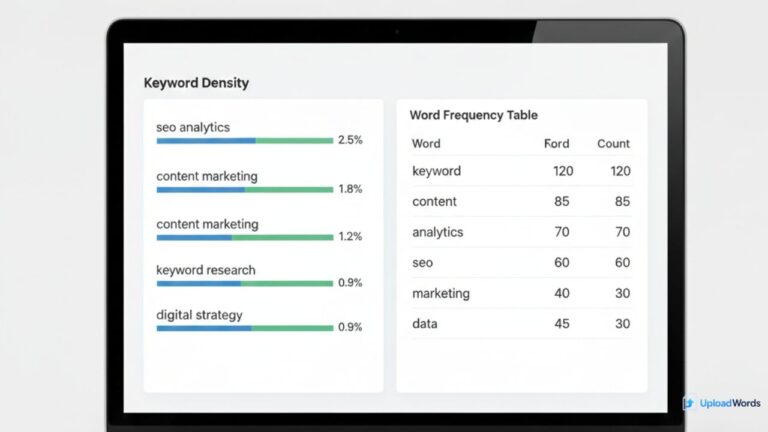
Need to measure how often a keyword appears in your content? A keyword density checker helps you calculate keyword usage as a percentage so you can optimize for clarity without drifting into keyword stuffing. Whether you’re editing a blog post, landing page, product description, or SEO brief, keyword density checks can reveal repetition patterns, overused phrases, and missed topic signals.
If you want a broader workflow than density alone—word count, top terms, keyword table, and quick analysis—use the keyword density tool inside UploadWords to paste your text and review results instantly.
This guide explains what keyword density is, how an online keyword density checker works, and how to interpret results the right way. You’ll also find practical ranges, common mistakes, and a comparison section with popular SEO tools—without overhyping density as a “magic ranking factor.”
What Is Keyword Density?
Keyword density is the percentage of times a keyword (or phrase) appears in your content compared to the total word count. It’s a quick way to measure repetition and check if your writing is balanced.
Here’s the simple idea:
- Too low can mean your page doesn’t clearly signal the topic.
- Too high can make content sound spammy or repetitive.
- Just right usually looks natural, readable, and aligned with the page’s intent.
For a deeper explanation of keyword density meaning (and why it’s not a strict ranking rule), see our full guide.
How a Keyword Density Checker Works
A keyword density analyzer scans your text, counts words, then calculates how frequently keywords appear. Most tools show:
- Total word count
- Keyword count (how many times each keyword appears)
- Keyword density percentage for each term
- Top phrases (2-word, 3-word, and sometimes 4-word terms)
This is why people also call it a keyword density calculator—it automates the math so you can focus on editing decisions.
Some tools also display a word frequency table, which works like a keyword density counter for repeated terms. That’s useful for catching accidental repetition like “in this guide” or “best tool” appearing too many times.
How to Use a Free Keyword Density Checker
Here’s a simple workflow you can follow with any free keyword density checker:
Step 1: Paste your content
Copy your draft from WordPress, Google Docs, or a content brief and paste it into the tool. Try to paste only the main body text (avoid menus or sidebar text if you copied from a live page).
Step 2: Run the analysis
The tool will calculate total words and highlight top repeating terms. If the tool supports phrase analysis, you’ll see common 2–3 word phrases as well.
Step 3: Check your primary keyword and close variants
Look at your primary keyword’s density. If it’s extremely low, your page may need clearer topical signals. If it’s extremely high, rewrite repetitive sentences.
Step 4: Fix repetition with smarter edits (not stuffing)
Instead of forcing the exact keyword into more lines, improve topic clarity by:
- Adding helpful sub-sections that answer real user questions
- Using natural variations and related terms
- Replacing repeated phrases with clearer wording
- Improving headings and structure
If you want a full text-level review (not just density), you can also use UploadWords to analyze longer content in one place—word count, top keywords, and more.
What’s a Good Keyword Density Percentage?
There is no perfect number that guarantees rankings. Still, many natural pages often fall around 0.5%–2.5% for the main keyword. The correct range depends on the topic, page length, and how naturally the keyword fits.
Use density like a “warning light”:
- 0%–0.2%: you may not be signaling the topic clearly (especially for long pages).
- 0.5%–2.5%: often looks natural for many informational pages.
- 3%+: may be fine in some cases, but frequently indicates repetition—re-check readability.
The best test: read the content out loud. If it sounds repetitive or forced, reduce repetition—even if the “percentage” looks acceptable.
Keyword Density for SEO: What It Helps With (And What It Doesn’t)
Keyword density is helpful when it improves clarity and prevents over-optimization. But it doesn’t replace modern SEO fundamentals like intent match, topic depth, and trust.
What keyword density checks can help you do
- Spot repetitive writing and rewrite for readability
- Confirm your main topic is present in key areas (title, intro, headings)
- Identify overused filler phrases and reduce “fluff”
- Find accidental keyword stuffing in AI drafts or templates
What keyword density checks cannot guarantee
- They can’t guarantee rankings in Google
- They don’t measure search intent satisfaction
- They don’t replace content quality, authority, or internal linking
That’s why a tool-based workflow works best: use density as a quick check, then improve structure, depth, and usefulness.
Single Words vs Phrases: Why Phrase Analysis Matters
Many users focus on single-word repetition, but phrase-level repetition often matters more for editing and SEO clarity. A good keyword density analysis tool will show common 2-word and 3-word phrases, helping you catch repeated sentence patterns.
Example:
- Single word: “tool” (may appear naturally without meaning much)
- Phrase: “keyword density checker” (closer to real search intent)
When you’re optimizing, it’s often better to ensure your key phrases appear naturally in important sections rather than repeating one word throughout the page.
Keyword Density Checker vs Google Keyword Density Checker (Do You Need “Google”?)
People sometimes search for a “google keyword density checker,” but Google doesn’t provide an official keyword density tool. Keyword density is a content-analysis concept, so third-party tools (and on-site tools like UploadWords) are what you’ll use in practice.
The best approach is to choose a tool that is fast, easy, and consistent—so you can compare content drafts in the same environment. Consistency matters more than chasing small differences between tools.
Competitor Comparison (Only Once)
Many SEO platforms include density-style checks or content analysis features. For example, you may come across Yoast keyword density guidance inside WordPress, or see related tools and reports like SEMrush keyword density insights, a Moz keyword density checker style workflow, or older references such as the SEO Book / Seobook keyword density tool. These can be helpful for on-page review, but your goal should remain the same: write naturally, avoid stuffing, and use density as a readability and repetition check—not as a hard ranking rule.
Common Mistakes When Using an Online Keyword Density Checker
1) Chasing a “perfect” density number
If you rewrite content just to hit 2%, you can harm clarity. Use density to detect extremes, not to force numbers.
2) Overusing the exact match keyword everywhere
Modern SEO rewards natural language. Use variations where they make sense and focus on answering the user’s question. Repeating the same phrase in every paragraph is a common sign of over-optimization.
3) Ignoring headings and structure
A clear H1, helpful H2s, and a strong intro/outro often do more for SEO than repeating keywords. Density tools can’t replace good structure.
How to Improve Keyword Usage Without Increasing Density
If your content feels off-topic, you don’t always need to repeat the keyword more. Instead:
- Add missing subtopics (FAQs, examples, steps)
- Use natural variations and related terms
- Rewrite repetitive sections into clearer explanations
- Strengthen internal linking and topical clusters
If you want to understand the underlying concept better, our guide on keyword density meaning explains how density fits into SEO today.
FAQs
What is a keyword density checker?
A keyword density checker is a tool that calculates how often a keyword appears in your content and shows the result as a percentage. It helps you spot repetition, avoid keyword stuffing, and keep writing natural.
Is there a free keyword density checker online?
Yes. Many tools offer free checks where you paste text and see keyword counts and percentages. A free online keyword density checker is best used as a quick editing step before publishing.
What is a good keyword density percentage?
There is no fixed ideal number. Many natural pages fall around 0.5%–2.5% for a primary keyword, but it depends on topic and writing style. Prioritize readability and use tools to identify extreme repetition.
Can keyword density be too high?
Yes. If a keyword appears unnaturally often, the content can become repetitive and may look like keyword stuffing. When density is high, rewrite for clarity and use variations where appropriate.
How do I calculate keyword density?
Keyword density is calculated as: (keyword count ÷ total words) × 100. If you want the full formula breakdown, see how to calculate keyword density.
Conclusion
A keyword density checker is most useful when you treat it as an editing tool. Use it to spot repetition, improve readability, and confirm topical clarity—then focus on what matters most: satisfying search intent with helpful, well-structured content.
To understand the math behind density and avoid common mistakes, see our guide on how to calculate keyword density.
Quick Tools & Next Steps
Use these pages to improve your content workflow:
- Keyword density tool — paste text and review word count and top terms.
- Keyword density meaning — understand what density really means in SEO.
- Calculate keyword density — learn the formula and do the math correctly.
Tip: Run density checks after your final edit. If the content sounds repetitive, rewrite for clarity—not for a number.

As a digital marketer, she has received multiple international awards, including Campaign of the Year at the 2023 European Content Awards and Best Use of Content Marketing at the 2022 Global Search Awards. Nicai holds an MSc in Marketing (First Class Honours) from the UCD Smurfit Graduate Business School and she has also completed the Artificial Intelligence Programme at Oxford University’s Saïd Business School. She is also a contributing writer for publications such as Entrepreneur and Esquire.

