

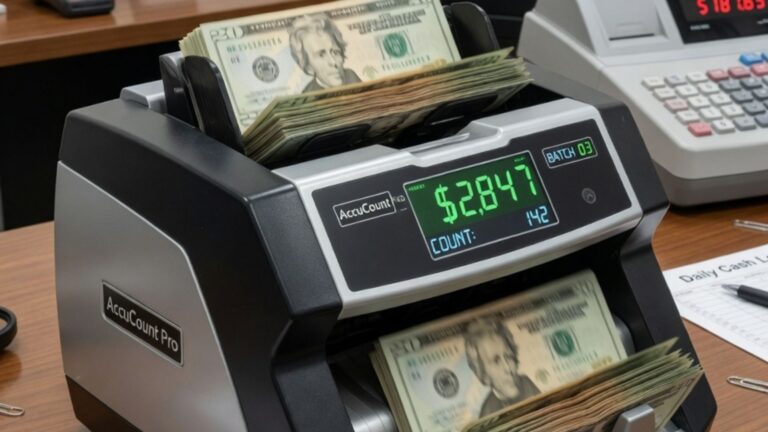
In the fast-paced arenas of retail, banking, and hospitality, cash remains a dominant and irreplaceable medium of exchange. However, the manual handling of physical currency is fraught with operational hazards. Human error in tallying, the constant threat of counterfeit infiltration, and the sheer labor hours consumed by end-of-day reconciliation can severely erode profit margins. To combat these vulnerabilities, modern enterprises must transition from manual tallying to automated solutions. Integrating a cash counting machine into daily operations is no longer a mere convenience; it is a strategic imperative for safeguarding assets, optimizing labor, and ensuring the highest standards of financial accuracy. This comprehensive guide explores the technology, benefits, and strategic selection of cash handling equipment designed to fortify your business’s financial infrastructure.
The Evolution of the Cash Counting Machine
The journey from manual ledger tallying to the sophisticated bill counters of today represents a significant leap in financial technology. Early mechanical devices required tedious hand-cranking and could only provide a basic numerical count, offering no security against fraudulent notes. As global commerce expanded and the sophistication of counterfeiters grew, the industry responded with advanced electronics. Today’s currency counting devices are marvels of optoelectronic engineering. They utilize high-speed microprocessors, complex sensor arrays, and intelligent software to not only count hundreds of bills per minute but to simultaneously authenticate them, recognize denominations, and compile comprehensive financial reports. This evolution has transformed the cash counting machine from a simple arithmetic tool into a critical component of comprehensive cash management solutions.
How a Cash Counting Machine Works: The Mechanics
Understanding the internal mechanics of these devices highlights their value and reliability. While models vary in complexity, the fundamental process of high-speed currency processing remains consistent across modern hardware.
The Friction Feeding System
The core of any bill counter is its friction feeding mechanism. A stack of banknotes is placed in the hopper, and a combination of a high-speed rubber roller and a retard wheel work in tandem. The main roller grips the bottommost bill and pulls it into the machine, while the retard wheel momentarily stops the second bill, ensuring strict single-note separation. This precise mechanical engineering prevents double-counts, misfeeds, and jamming, allowing the machine to process between 1,000 and 1,900 bills per minute with flawless accuracy.
Optoelectronic Sensor Arrays
As the banknote travels through the internal track, it passes through a series of sophisticated sensors. Infrared sensors detect the presence, width, and length of the bill, ensuring that torn, folded, or incorrectly sized papers are rejected. Magnetic sensors detect the presence of magnetic ink, which is used in the secure printing of most global currencies. Ultraviolet sensors check for the specific UV fluorescence of the paper itself, instantly flagging standard wood-based paper often used by counterfeiters. The integration of these sensors ensures that every bill is counted accurately and scrutinized for authenticity.
Types of Cash Counting Machines
The market offers a diverse array of cash handling equipment, tailored to different volumes, security requirements, and operational complexities. Selecting the right type is the first step toward operational optimization.
Basic Bill Counters (Single Denomination)
A basic bill counter is designed for high-speed, volumetric counting. These machines count the total number of bills passing through the sensor, regardless of their denomination. They are ideal for businesses that batch large amounts of a single denomination, such as a bank teller wrapping rolls of twenties, or a retail manager counting a generic cash drawer at the end of the night. While they offer high speed and reliability, they require the user to pre-sort the cash by denomination before counting, as the machine will add a ten-dollar bill and a one-dollar bill equally to the total count.
Mixed Money Counters (Value Counting)
For businesses handling diverse cash inflows, a mixed money counter is the ultimate productivity tool. Equipped with advanced Contact Image Sensors (CIS) or sophisticated optical recognition software, these machines read the denomination of each bill as it passes through. They simultaneously calculate the total piece count and the total monetary value of a mixed stack of currency. A user can drop a messy stack of ones, fives, tens, and twenties into the hopper, and within seconds, the screen will display the exact dollar value and a breakdown of the denominations. This technology drastically reduces the time spent sorting and tallying, making it a cornerstone of modern retail cash management.
Coin Counting and Sorting Machines
Currency handling is not limited to banknotes. High-volume environments like car washes, laundromats, and vending operators require robust coin processing. Coin counting machines use rotating discs with precision-milled holes to sort coins by diameter and thickness. As the coins pass through, electronic sensors tally the exact count and value. Commercial-grade coin sorters can separate coins into individual bags or wrappers, drastically reducing the agonizing manual labor of rolling coins by hand.
Bank-Grade and Heavy-Duty Counters
Financial institutions and large-scale cash processing centers require equipment that can withstand continuous, daily operation. Bank-grade machines feature larger hoppers, wider output stackers, and ultra-high-speed processing capabilities. They also incorporate the most advanced counterfeit detection suites and often feature dual-pocket designs. A dual-pocket machine has a main stacker for approved bills and a secondary reject pocket. If a counterfeit, misfed, or unrecognizable bill is detected, it is diverted to the reject pocket without stopping the machine, allowing the operator to continuously feed currency without interruption.
The Critical Role of Counterfeit Detection
The proliferation of high-quality, commercially available printing technology has made counterfeiting a severe threat to businesses of all sizes. Relying on the human eye or cheap counterfeit detector pens—which only check for the presence of starch in the paper and are easily fooled by washed lower-denomination bills—is a dangerous liability. A modern cash counting machine serves as a vital frontline defense against fraudulent currency.
Ultraviolet (UV) Detection
Genuine banknotes are printed on specialized paper, often composed of cotton and linen, which contains specific UV-fluorescent properties. When exposed to ultraviolet light, the genuine paper will emit a distinct glow, and hidden security threads embedded in the bill will illuminate. Counterfeit bills printed on standard wood-based paper will absorb the UV light and appear dull, immediately alerting the operator to the fraud.
Magnetic (MG) Detection
Central banks utilize highly specialized, magnetic-based inks to print specific elements on their currency, such as serial numbers and security strips. A cash counting machine equipped with magnetic sensors detects the presence and specific pattern of these magnetic signatures. If a bill lacks the magnetic properties of genuine currency, or if the pattern is incorrect, the machine will flag the note as suspect.
Infrared (IR) Detection
Infrared detection is one of the most secure and advanced forms of counterfeit verification. Genuine banknotes feature IR-metameric inks that absorb or reflect infrared light in specific, predetermined patterns that are invisible to the naked eye. The machine’s IR sensors read these patterns, verifying the bill’s authenticity at a microscopic level. This is highly effective against “superdollars” and other high-grade counterfeits that may successfully mimic UV and MG features.
Contact Image Sensors (CIS) and Size Detection
Advanced mixed money counters utilize CIS technology to scan a high-resolution image of the passing banknote. This image is compared against a database of genuine currency templates, verifying the intricate printed patterns, micro-printing, and color shifts. Simultaneously, the machine measures the exact dimensions of the bill. Because counterfeiters sometimes “wash” lower-denomination bills and reprint them as higher denominations, the size detection feature can identify these altered notes, as the size of the original paper may not perfectly match the standard dimensions of the higher denomination.
The Business Case: ROI of a Cash Counting Machine
Investing in commercial cash handling equipment requires capital, but the return on investment is rapid and multifaceted. The financial and operational benefits extend far beyond simple arithmetic.
Drastic Reduction in Labor Costs
Manual cash counting is agonizingly slow. A seasoned cashier might be able to count and strap a stack of one hundred bills in two to three minutes, including the time to recount for verification. A cash counting machine can perform the same task in under ten seconds. When multiplied across daily tills, multiple registers, and end-of-week audits, the time savings are staggering. This frees up managers and employees to focus on customer service, merchandising, and revenue-generating activities rather than being locked in a back office counting paper.
Elimination of Human Error and Cash Discrepancies
Even the most diligent employees make mistakes. A missed bill, a miscounted stack, or a mental lapse can result in a cash drawer discrepancy. These discrepancies, whether overages or shortages, create accounting nightmares and can erode trust between management and staff. Automated currency counting eliminates the human element from the tallying process, ensuring that the count is accurate to the bill every single time. This precision is vital for maintaining tight financial controls and ensuring accurate daily reconciliation.
Enhanced Loss Prevention and Security
Beyond counterfeit detection, these machines play a crucial role in internal loss prevention. By removing the manual counting process, businesses eliminate the opportunity for “skimming” or pocketing cash during the counting process. Furthermore, machines with built-in printers or data connectivity create an immutable, timestamped audit trail of exactly how much cash was processed, by whom, and when. This transparency is a powerful deterrent against internal theft and provides invaluable data for forensic accounting if discrepancies arise.
Improved Customer Experience
In retail and hospitality, speed at the checkout directly correlates to customer satisfaction. By utilizing a bill counter to quickly and accurately verify large cash payments (such as car payments, hotel deposits, or large retail purchases), businesses can process transactions faster and with greater confidence. This eliminates the awkward and time-consuming process of a cashier slowly counting out loud, holding up the line, and making the customer feel distrusted.
Key Features to Consider When Buying a Cash Counting Machine
Selecting the ideal equipment requires a careful assessment of your specific operational needs. With a myriad of features available, prioritizing the right specifications will ensure you maximize your investment.
Counting Speed and Hopper Capacity
Evaluate the volume of cash your business processes daily. A small boutique may only need a machine with a 500-bill-per-minute speed, while a high-volume grocery store or casino requires a heavy-duty machine capable of processing 1,500 bills per minute. Similarly, hopper capacity—the number of bills the machine can hold at once—is critical. A larger hopper reduces the need for constant reloading, allowing the operator to process large cash drops quickly and efficiently.
Batch Processing and Adding Functions
Batch processing is an essential feature for businesses that prepare bank deposits or cash drawers. This function allows the user to set a specific number of bills (e.g., 50 or 100), and the machine will automatically pause once that count is reached, creating perfect straps for the bank. The adding function is equally important; it allows the operator to run multiple stacks of cash through the machine, maintaining a running grand total of all bills processed, which is invaluable for end-of-day reconciliation.
Display Interface and Connectivity
Look for a machine with a large, clear, and backlit LCD or LED display. This ensures that the count is easily readable from a distance or in poorly lit back-office environments. Modern machines also offer connectivity features such as USB ports, RS232 interfaces, or Wi-Fi connectivity. These features allow the cash counting machine to connect directly to a computer, receipt printer, or point-of-sale system, facilitating seamless data integration and automated reporting.
Software Updateability
Currency designs change frequently, and counterfeiters are constantly refining their methods. A static machine will eventually become obsolete. It is crucial to invest in a machine whose software and currency recognition databases can be updated. This ensures that your equipment can accurately recognize new banknote designs and detect the latest counterfeit threats, protecting your investment for years to come.
Best Practices for Operating and Maintaining Your Equipment
To ensure the longevity and accuracy of your cash handling equipment, proper maintenance and operational protocols must be strictly enforced.
Regular Cleaning of Sensors
Dust, paper lint, and ink residue naturally accumulate inside the machine as banknotes are processed at high speeds. Over time, this debris coats the optical and magnetic sensors, leading to miscounts, error codes, and false counterfeit alarms. It is imperative to regularly clean the sensor arrays using a specialized cleaning card—similar to a thick, slightly abrasive credit card—moistened with a recommended cleaning solution. Running the card through the machine removes debris and restores the sensors to peak sensitivity.
Proper Bill Preparation
While these machines are robust, they are not designed to process wet, heavily crumpled, or severely torn currency. Feeding damaged bills can cause jams, damage the internal rollers, and skew the count. Operators should always inspect stacks of cash before feeding them into the hopper, removing paper clips, staples, and rubber bands, and smoothing out severely crumpled bills. This simple step drastically reduces mechanical wear and tear.
Scheduled Calibration and Servicing
Just like any precision instrument, a cash counting machine requires periodic calibration. If you notice an increase in error rates or inconsistent counterfeit detection, it may be time for professional servicing. Establishing a service contract with a reputable vendor ensures that your machine is regularly inspected, calibrated, and fitted with replacement parts before minor issues escalate into catastrophic failures.
The Future of Cash Handling Equipment
The integration of cash counting hardware with broader digital ecosystems represents the next frontier in cash management solutions. The future lies in smart, connected devices that operate as nodes within a comprehensive enterprise resource planning (ERP) system.
Cloud Connectivity and IoT Integration
Internet of Things (IoT) enabled cash counting machines are transforming back-office operations. These devices transmit real-time counting data directly to cloud-based dashboards. A regional manager can instantly see the exact cash volume processed at a specific retail location on a given day, without waiting for a manual spreadsheet report. This real-time visibility allows for optimized cash-in-transit pickups, ensuring that armored vehicles are dispatched only when cash levels reach a profitable threshold, thereby reducing security costs.
Artificial Intelligence and Predictive Analytics
The incorporation of artificial intelligence into bill counters is enhancing both security and operational efficiency. AI algorithms can analyze the physical characteristics of the bills passing through the machine, learning to identify subtle anomalies in counterfeit notes that might evade traditional sensor checks. Furthermore, AI can provide predictive analytics regarding cash flow, helping businesses anticipate peak cash periods and adjust their float and staffing levels accordingly.
Conclusion: Securing Your Financial Infrastructure
The manual handling of physical currency is a liability that modern businesses can no longer afford. The risks of human error, the devastating impact of counterfeit fraud, and the sheer waste of valuable labor hours demand a technological upgrade. By implementing a high-quality cash counting machine, enterprises can achieve unprecedented levels of accuracy, security, and operational efficiency. Whether your business requires a simple single-denomination counter for daily tills or a sophisticated mixed-money counter with full CIS counterfeit detection, the right equipment is a vital investment in your financial infrastructure. By prioritizing advanced detection technologies, ensuring regular maintenance, and embracing the future of connected cash management solutions, you can transform your cash handling from a vulnerable operational bottleneck into a secure, streamlined asset.
Frequently Asked Questions (FAQs)
1. What is a cash counting machine?
It is an electronic device designed to rapidly and accurately count the total number of banknotes, often featuring advanced sensors to detect counterfeit currency and sort bills by denomination.
2. How does a mixed money counter work?
Mixed money counters utilize advanced optical sensors and image recognition software to identify the denomination of each bill as it passes through, simultaneously calculating the total piece count and the total monetary value of a mixed stack.
3. Can a cash counting machine detect all counterfeit bills?
While no device is 100% foolproof, advanced machines utilizing a combination of UV, MG, IR, and CIS detection technologies can identify the vast majority of modern counterfeits, including washed bills and high-grade forgeries.
4. Do I need to sort my cash before using a bill counter?
If you are using a basic single-denomination counter, you must sort the cash first; however, a mixed money counter will automatically recognize and total different denominations, eliminating the need for presorting.
5. How often should I clean my cash counting machine?
You should clean the internal sensors and rollers at least once a week, or more frequently in high-volume environments, using a specialized cleaning card to prevent dust and ink residue from causing miscounts.
6. What is the difference between a single-pocket and a dual-pocket bill counter?
A single-pocket machine stops entirely when it encounters a misfed or suspect bill, whereas a dual-pocket machine diverts the rejected bill into a separate pocket, allowing the operator to continue counting without interruption.


