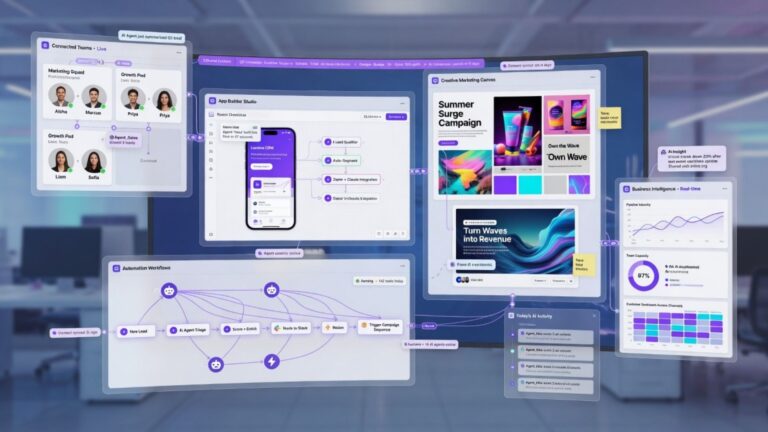
Businesses are under pressure to move faster, create more content, build better digital tools, and make smarter decisions without constantly increasing headcount or software costs. Converge represents the growing shift toward AI-native work, where teams use connected AI agents, shared context, creative automation, and app-building tools to reduce fragmented workflows. Instead of treating artificial intelligence as a single chatbot or isolated productivity assistant, AI-native platforms aim to bring development, marketing, content creation, automation, and business execution closer together.
In 2026, many organisations are not asking whether AI is useful. They are asking how to use it in a practical, secure, and outcome-focused way. The challenge is that many teams now rely on disconnected AI tools for writing, design, coding, video, analytics, and operations. This can create tool overload, repeated prompts, inconsistent outputs, and poor collaboration. A more integrated platform approach can help teams work with AI more strategically.
This guide explains what Converge is positioned to offer, why AI-native workflows matter, and what businesses should consider before adopting connected AI platforms.
What Is Converge?
Converge is an AI platform concept focused on bringing teams, context, and specialised AI agents into one connected environment. Its positioning centres on helping users move beyond isolated tools and toward workflows where different AI capabilities can work together.
Rather than using one platform for coding, another for design, another for video, and another for marketing planning, an AI-native environment aims to reduce switching and preserve shared context. This matters because modern business work often requires multiple steps: ideation, creation, review, deployment, distribution, analysis, and iteration.
A platform like Converge may support areas such as:
- AI-assisted app development
- Creative and marketing content production
- Workflow automation
- Team collaboration
- Shared business context
- AI agents for specialised roles
- Brand-consistent creative output
- Product prototyping
- Content planning and execution
- Faster iteration across projects
The broader idea is not simply generating content or code. It is helping teams move from idea to usable business output more efficiently.
Why Converge Matters for AI-Native Work
Converge matters because the way people use AI is changing. Early AI adoption often focused on individual productivity: writing emails, summarising documents, generating ideas, or answering questions. While useful, these tasks only represent a small part of what AI can do.
AI-native work goes further. It asks how AI can support entire workflows, not just individual outputs. For example, a marketing team may need a campaign concept, landing page copy, product visuals, short-form videos, ad variations, and performance analysis. A startup founder may need a prototype, backend logic, payment setup, website deployment, and launch assets. These are multi-step workflows that benefit from connected context.
The strongest AI platforms are likely to help teams:
- Reduce repetitive manual work
- Improve speed from idea to execution
- Keep creative and technical work aligned
- Use AI agents for specialised tasks
- Maintain consistency across outputs
- Support smaller teams with broader capabilities
- Improve collaboration between roles
- Create business outcomes, not just drafts
This is why connected AI ecosystems are becoming more important for modern teams.
Converge and Shared Context Across Teams
One of the biggest weaknesses of disconnected AI tools is context loss. A team may explain the same brand guidelines, customer audience, product details, technical requirements, and project goals repeatedly across different tools. This wastes time and can create inconsistent results.
Shared context allows AI systems and team members to work from a common understanding. For example, if a business has defined its brand voice, product positioning, audience segments, design style, and campaign goals, that context can support multiple outputs.
Shared context may improve:
- Brand consistency
- Content relevance
- Team alignment
- Faster project handover
- Reduced repeated prompting
- More accurate AI outputs
- Better collaboration between creative and technical teams
For AI-native businesses, context becomes a strategic asset. The more clearly a team defines its goals, rules, assets, and workflows, the more useful AI can become.
Converge for App Development and Product Building
One important use case for AI-native platforms is app development. Many businesses have ideas for internal tools, customer portals, landing pages, prototypes, automations, or SaaS products, but they lack enough development resources to build quickly.
Converge is associated with AI development support through app-building workflows that can help users move from idea to functional product. In this kind of workflow, AI may assist with planning, interface generation, code creation, backend setup, deployment, and iteration.
AI-assisted app development can support:
- Startup prototypes
- Internal business tools
- MVP development
- Landing pages
- Customer portals
- Workflow dashboards
- Automation interfaces
- Product experiments
- Client demos
However, AI-generated applications should still be reviewed carefully. Security, scalability, code quality, privacy, user permissions, payment handling, and data storage all require responsible oversight. AI can accelerate development, but human review remains essential.
Converge for Creative and Marketing Workflows
Marketing teams often face constant demand for more content: videos, social posts, campaign assets, product images, ads, landing pages, emails, and brand visuals. A connected AI creative platform can help reduce production bottlenecks.
Converge is also associated with AI-powered creative and marketing tools that support content generation, visual design, video workflows, storyboarding, brand assets, and campaign execution. This can be useful for small teams, creators, agencies, ecommerce businesses, and founders who need professional-looking output without managing too many separate tools.
AI creative workflows may help with:
- Social media videos
- Promotional content
- Ad concepts
- Product visuals
- Campaign storyboards
- Voiceover planning
- Design variations
- Brand-consistent graphics
- Short-form content
- Creative testing
The key is using AI to support strategy, not replace it. Strong marketing still needs audience understanding, positioning, messaging, brand judgement, and performance review.
Converge and Automation for Smaller Teams
Many small teams want to do more without hiring for every specialised role. AI agents can help by supporting tasks that would normally require separate skills, such as development, copywriting, design, research, editing, or analytics.
This does not mean AI replaces employees. Instead, it can help people focus on higher-value decisions while AI handles repetitive or time-consuming execution tasks.
For smaller teams, Converge-style workflows may support:
- Faster campaign creation
- More frequent product experiments
- Reduced dependency on multiple subscriptions
- Quicker internal tool development
- Better content output consistency
- Less manual coordination
- More scalable operations
Still, businesses should avoid assuming AI will solve every operational problem automatically. Clear processes, human accountability, and quality control are still needed.
Choosing Converge for Business Productivity
Before adopting any AI platform, businesses should evaluate whether it fits their actual workflow. A platform may look impressive in a demo but still fail if it does not match team needs, data policies, budget, or technical requirements.
Important evaluation questions include:
- What business problems will the platform solve?
- Which teams will use it?
- Does it reduce tool switching?
- Does it support collaboration?
- Can it maintain brand or project context?
- What security and privacy controls are available?
- How are outputs reviewed?
- Does it integrate with existing tools?
- What training will users need?
- How will success be measured?
The best AI adoption strategy starts with use cases, not hype. Teams should identify where work is slow, repetitive, expensive, or fragmented, then test whether AI can improve that specific process.
Risks and Considerations With AI-Native Platforms
AI-native platforms offer real potential, but businesses should also understand the risks. AI outputs may contain errors, inconsistencies, bias, hallucinated details, or security weaknesses if not reviewed properly.
Common risks include:
- Overreliance on AI outputs
- Poor quality control
- Inaccurate generated content
- Weak review processes
- Data privacy concerns
- Copyright or licensing uncertainty
- Brand inconsistency
- Security risks in generated code
- Lack of employee training
- Unclear ownership of AI-generated assets
To reduce risk, businesses should create guidelines for AI use. These may include approval workflows, disclosure rules, data handling policies, review standards, and clear responsibilities for final decisions.
Best Practices for Using Converge Effectively
To get better results from Converge or any AI-native platform, teams should treat AI as part of a structured workflow.
Useful best practices include:
- Define project goals clearly
- Create brand and content guidelines
- Use shared knowledge and approved assets
- Review all outputs before publishing
- Test generated code before deployment
- Keep humans accountable for decisions
- Train teams on responsible AI use
- Track productivity and quality improvements
- Start with pilot projects
- Improve workflows based on feedback
AI performs better when the business provides clear direction. Vague input often leads to vague output. Strong context, examples, constraints, and review standards improve results.
Future of Converge and AI-Native Business Platforms
The future of business software is likely to become more agent-based, contextual, and workflow-driven. Instead of separate tools that each perform one function, teams may increasingly use platforms where multiple AI agents collaborate around shared goals.
This shift may change how businesses approach:
- Product development
- Marketing production
- Internal operations
- Customer experience
- Data analysis
- Business automation
- Team collaboration
- Creative testing
- Digital transformation
Converge reflects this broader movement toward AI-native execution, where AI is not only an assistant but part of the operating system for modern work. The winners will be teams that combine AI speed with human judgement, ethical standards, and strategic clarity.
Conclusion: Converge and the Shift Toward AI-Native Work
Converge represents a practical direction for businesses that want to move beyond isolated AI tools and build more connected, outcome-focused workflows. By bringing together shared context, AI agents, app-building support, creative production, and automation, platforms like Converge can help teams work faster and reduce operational friction. However, successful adoption requires clear goals, responsible use, strong review processes, and realistic expectations. AI-native work is not about removing human judgement; it is about giving teams better leverage so they can build, create, test, and improve with more focus and speed.
FAQs
What is Converge?
Converge is an AI platform focused on connected AI-native workflows, shared context, app development, creative production, and business execution.
How can Converge help businesses?
It can help teams reduce tool switching, automate workflows, create content, build products, and improve productivity with AI-assisted processes.
Is Converge only for developers?
No. Converge-style workflows can support developers, marketers, creators, founders, agencies, and business teams.
Can Converge support marketing content?
Yes, it is associated with creative and marketing workflows such as videos, visuals, campaign assets, and brand-consistent content.
What should businesses check before using Converge?
Check use cases, privacy controls, integrations, collaboration features, output quality, pricing, and team training needs.
Is AI-generated work from Converge ready to publish immediately?
Not always. AI outputs should be reviewed for accuracy, quality, brand fit, security, and compliance before publishing or deployment.