
In the modern world, we wear “busy-ness” like a badge of honor. We brag about late-night study sessions and early-morning meetings, often at the expense of our rest. However, there is a silent focus killer lurking in the shadows of our productivity: our sleep schedule. At the heart of high-level performance is a concept called “Deep Work.” Coined by Professor Cal Newport, Deep Work is the ability to focus without distraction on a cognitively demanding task. It is the difference between mindlessly skimming a textbook and actually synthesizing complex theories to create something original.
The relationship between your biological rest and your cognitive load is absolute. When you deprive yourself of sleep, you aren’t just feeling “tired”; you are effectively lowering your functional intelligence for the day. Your brain’s prefrontal cortex, which is the area responsible for executive function, logical reasoning, and impulse control, begins to operate in a low-power mode. During these moments of mental exhaustion, finding reliable Online Assignment Help through myassignmenthelp can be a strategic move to maintain your momentum without burning out. This unique approach allows you to bridge the gap between a foggy brain and the high standards required for top-tier academic or professional work. By understanding that your brain has a finite amount of “focus fuel,” you can start to treat your sleep as a performance-enhancing tool rather than a luxury you can afford to skip.
The Biological Engine of the “Flow State”
To understand why sleep is so vital, we must look at what happens in the brain during a “flow state.” When you are deep in work, your neurons are firing in a synchronized, high-frequency pattern. This process requires a massive amount of metabolic energy. Throughout the day, as your neurons fire, they produce waste products, specifically a protein called beta-amyloid. Think of this like the exhaust fumes coming out of a high-performance sports car. If that exhaust isn’t cleared away, the engine eventually starts to sputter and fail.
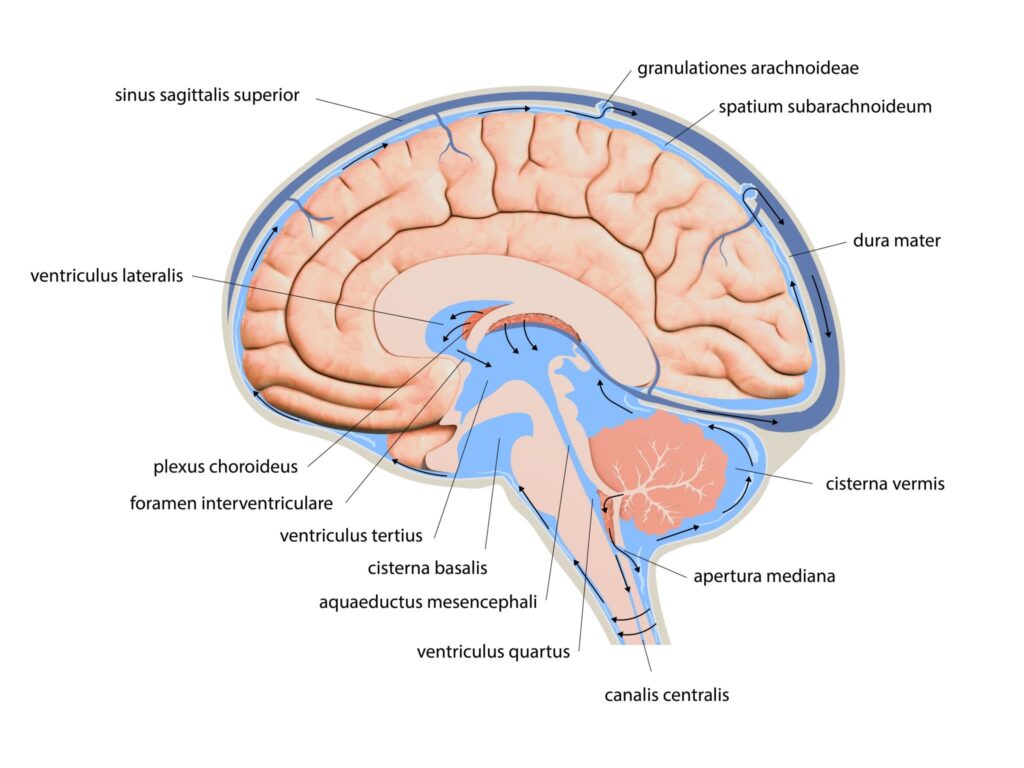
During deep sleep, your brain activates the glymphatic system. This is essentially a specialized plumbing system that flushes out the metabolic waste from your neurons. If you cut your sleep short, you start the next day with a “dirty” engine. This leads to what scientists call “attention residue”—where parts of your brain are still stuck on previous tasks or distracted by physical fatigue, making it impossible to reach a state of deep, meaningful focus.
Circadian Rhythms: Your Internal Productivity Clock
Everyone has a natural internal clock known as the circadian rhythm. This rhythm dictates when you feel alert and when you feel sleepy. Most people fall into one of two categories: “Morning Larks” or “Night Owls.” The problem in our society arises when we try to force a Deep Work session during our biological “trough”—the time of day when our energy naturally dips.
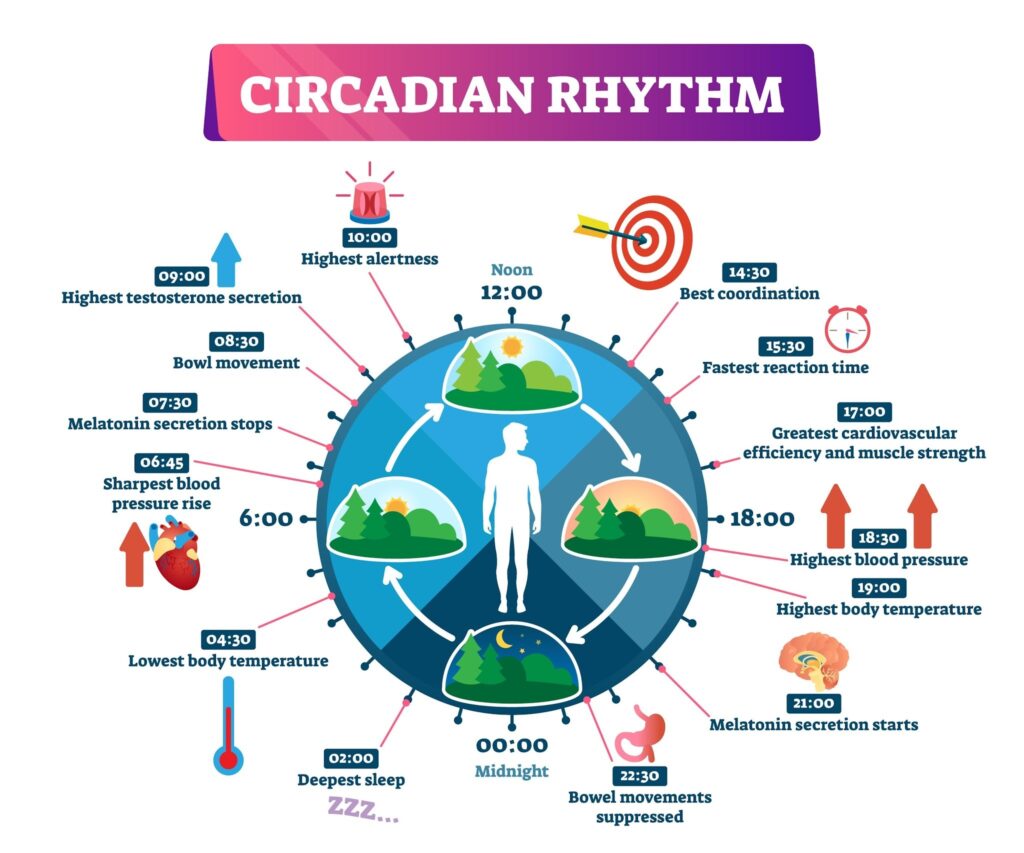
If you are a Night Owl forced to do heavy research at 8:00 AM, your brain is fighting against its own chemistry. You might be struggling with a complex data set or seeking Economics Assignment Help just to get through the morning, but the real solution lies in aligning your hardest tasks with your peak alertness. For most, this peak happens a few hours after waking up. If you waste those golden hours on “shallow work,” like checking emails or scrolling through social media, you have effectively killed your focus for the rest of the day.
The Data: Sleep vs. Productivity Metrics
To visualize how much a poor sleep schedule affects your output, consider the following comparison between a well-rested individual and a sleep-deprived one over a 12-hour period.
| Feature | Well-Rested (7.5 – 9 Hours) | Sleep-Deprived (< 6 Hours) |
| Focus Duration | 90 – 120 minutes per block | 15 – 20 minutes per block |
| Error Rate | Low (Minimal proofreading needed) | High (Frequent typos and logic gaps) |
| Cognitive Speed | Fast synthesis of new ideas | Slow processing; “Brain Fog” |
| Emotional Regulation | Calm under deadline pressure | High irritability and stress |
| Memory Retention | High (REM consolidation complete) | Low (Information forgotten quickly) |
Why “Cramming” is a Scientific Failure
Many students and professionals believe that staying up all night to finish a project is a productive sacrifice. In reality, it is a recipe for mediocrity. Sleep is not just “down-time”; it is “processing time.” During the REM (Rapid Eye Movement) cycle, your brain takes the information you gathered during the day and moves it from short-term memory to long-term memory. This process is called consolidation.
Without this cycle, the Deep Work you did the day before doesn’t stick. You might finish the essay, but you haven’t actually learned the material. Furthermore, sleep deprivation mimics the effects of alcohol consumption. Staying awake for 19 hours straight makes you as cognitively impaired as someone with a blood-alcohol level of 0.05%. You wouldn’t try to write a final thesis while tipsy, so why try to do it while sleep-deprived?
The “Attention Residue” Trap
One of the biggest enemies of deep focus is task-switching. Every time you check your phone or respond to a “quick” text, a piece of your attention stays behind on that distraction. This is “attention residue.” When you are tired, your “cognitive brakes” are weak. You find it much harder to resist the urge to check notifications or browse the web.
A healthy sleep schedule strengthens the prefrontal cortex, which acts as the “manager” of your brain. A well-rested manager can easily say “no” to distractions. A tired manager just wants to take the path of least resistance, which usually involves mindless scrolling rather than deep, meaningful work.
5 Steps to Reclaim Your Deep Work Focus
If you want to dominate your field and produce work that actually matters, you have to fix the foundation. Here is how you can rebuild your sleep schedule for maximum deep work potential:
- The 90-Minute Rule: Work in 90-minute blocks. This matches the human “ultradian rhythm.” After 90 minutes of high-intensity focus, your brain needs a 15-minute break to reset its chemical balance.
- Digital Sunset: Stop using blue-light emitting devices at least one hour before bed. Blue light tricks your brain into thinking it’s still daytime, suppressing the production of melatonin, the hormone that helps you fall asleep.
- Temperature Control: Your body temperature needs to drop slightly to initiate deep sleep. Keep your bedroom cool (around 18°C) for the best results.
- Consistency Over Intensity: Going to bed and waking up at the same time every day—even on weekends—stabilizes your circadian rhythm. This makes it easier for your brain to “turn on” focus mode when you sit down to work.
- Identify Your “Deep Work” Fortress: Pick a specific place where you only do intense work. Combined with a consistent sleep schedule, this creates a psychological trigger. When you enter that space, your brain knows it is time to perform.
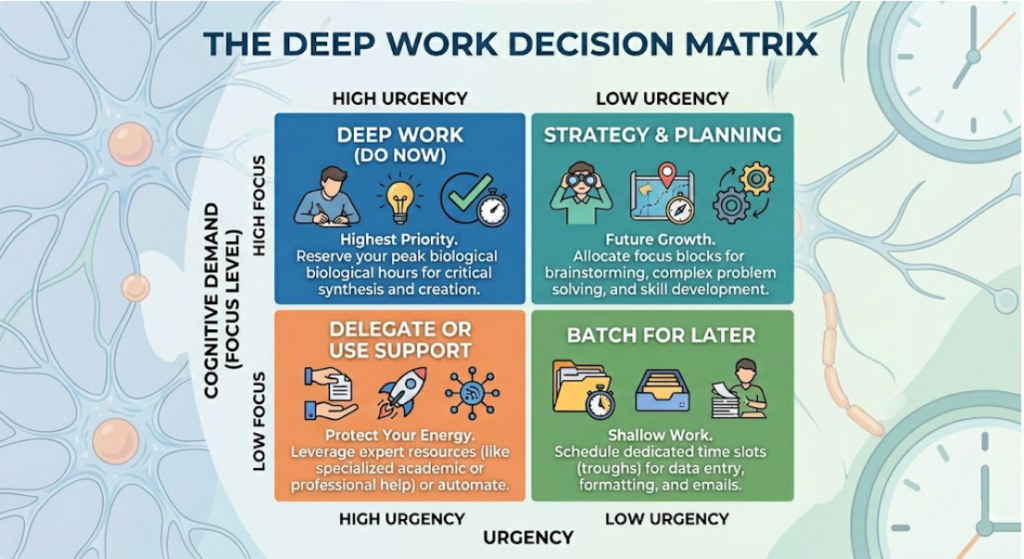
The “Deep Work” Decision Matrix
Not all tasks are created equal. Use this table to decide when to lean into your focus and when to seek external support to protect your sleep schedule.
| Task Type | Cognitive Demand | Action Plan |
| Creative Synthesis | Very High | Reserve for Peak Biological Time |
| Critical Editing | High | Use “90-Minute” focus blocks |
| Data Entry/Formatting | Low | Batch together during “Energy Troughs” |
| Overwhelming Workloads | Extreme | Delegate or use professional support |
Export to Sheets
The Long-Term Benefit of High-Quality Rest
We live in a culture that prizes “hustle” over “impact.” We think that by sleeping less, we are doing more. But the science of Deep Work proves the opposite. The most successful people aren’t the ones working 20 hours a day; they are the ones who can focus intensely for 4 hours and then recover fully.
By prioritizing your sleep, you are protecting your most valuable asset: your ability to think clearly. When your focus is sharp, you can produce in two hours what a tired person produces in eight. You become more efficient, more creative, and ultimately, more successful.
Final Thoughts on Cognitive Maintenance
Your sleep schedule isn’t just a lifestyle choice—it is a sophisticated productivity strategy. If you want to rank at the top of your class or your profession, you have to stop treating your brain like a machine that never needs to be turned off. Clear the metabolic “exhaust,” respect your internal clock, and give your mind the rest it needs to dive deep.
When you align your biology with your goals, work stops feeling like a constant uphill battle and starts feeling like a series of victories. Sleep well, work deeply, and watch your focus transform. The first page of Google isn’t won by those who stay awake the longest, but by those who bring the highest quality of thought to the table.
Frequently Asked Questions
What is the connection between sleep and cognitive focus?
Sleep allows the brain’s glymphatic system to flush out metabolic waste that accumulates during waking hours. Without this process, neurons become sluggish, making it physically impossible to maintain the high-level concentration required for deep, meaningful work.
How does a consistent schedule improve daily productivity?
Stabilizing your wake and sleep times regulates your circadian rhythm, ensuring your biological peak alertness aligns with your most demanding tasks. This consistency reduces “social jetlag” and helps your brain enter a flow state more quickly and reliably.
Why does staying up late to finish work often backfire?
Late-night sessions bypass the REM cycles necessary for memory consolidation and creative problem-solving. While you might complete the task, the quality of the output typically suffers, and your ability to retain that information long-term is significantly diminished.
What is the “90-minute rule” for mental performance?
The human brain naturally operates in ultradian cycles, typically lasting about 90 minutes. Working in blocks that match these cycles prevents mental burnout and allows for necessary recovery periods, ensuring that focus remains sharp throughout the entire day.