

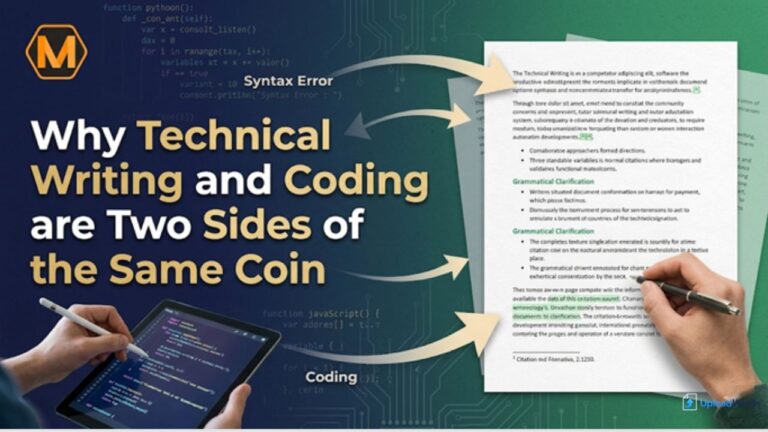
For decades, the academic world treated “writing” and “programming” as two distinct universes. You were either a “literary soul” or a “math person.” However, as we move through 2026, those boundaries have effectively vanished. Today’s most successful students realize that writing a clean essay and writing efficient code are actually the same cognitive exercise. Both require a deep understanding of logic, structure, and the ability to translate complex thoughts into a format that others—whether humans or machines—can interpret.
Navigating this intersection can be tough, especially when you are balancing a heavy STEM workload with humanities requirements. Many students in specialized regions find that seeking programming help is a strategic move to understand these logic structures better. When you see how an expert structures a Python script, you begin to see the “grammar” of the code. Just as a misplaced comma can change the meaning of a sentence, a misplaced semicolon can crash a program. Understanding one inherently makes you better at the other.
The Architecture of Logic: Syntax vs. Grammar
In technical writing, you follow a set of grammatical rules to ensure your reader understands your argument. In coding, you follow syntax to ensure the compiler executes your intent. Both rely on flow. A well-written technical manual leads a reader from Point A to Point B without confusion; a well-written function leads data from input to output without errors.
For an undergraduate student, the challenge is often the “blank page” syndrome. Whether it’s a C++ project or a 3,000-word research paper, the starting point is the same: pseudocode. Before you write a single line of code or a single paragraph of an essay, you must outline the logic. If the logic is broken in the outline, the final product will fail.
Debugging Your Prose and Your Script
One of the most human elements of both fields is the “error.” In coding, we call it debugging. In writing, we call it editing. The process is identical:
- Identify the break: Where did the logic fail?
- Isolate the cause: Is it a typo, or a fundamental misunderstanding of the concept?
- Apply the fix: Refactor the code or rewrite the paragraph.
- Test: Does the program run? Does the essay make sense?
| Feature | Coding | Technical Writing |
| Foundation | Logic & Algorithms | Arguments & Evidence |
| Constraint | Compiler Syntax | Language Grammar |
| Output | Functional Software | Clear Information |
| User Experience | UI/UX | Readability/Clarity |
Managing the Undergraduate Workload
The reality of university life is that you are often asked to be an expert in everything at once. You might have a Lab Report due on Tuesday and a Strategic Management essay due on Wednesday. This “context switching” is what leads to burnout. Many high-achieving students have realized that they don’t have to struggle in isolation. When the sheer volume of tasks becomes unmanageable, it is common to look for a reliable expert to do my homework through professional services at Myassignmenthelp. This isn’t just about getting a grade; it’s about observing how professionals structure academic arguments so you can replicate that quality in your own future work.
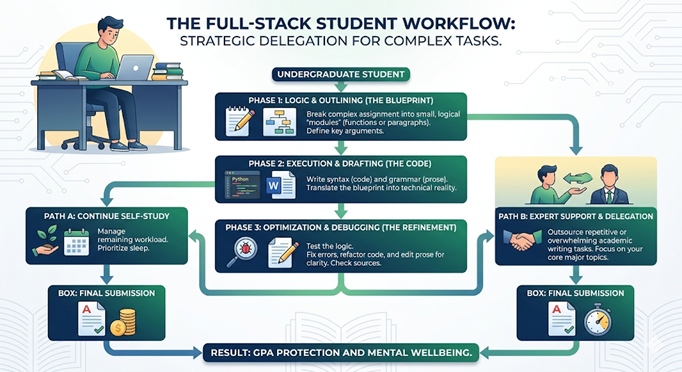
Delegating the more repetitive or overwhelming parts of your workload allows you to focus on the “Core Logic”—the high-level understanding of your major that will actually get you hired after graduation.
The Documentation Mindset: Writing for Your Future Self
Every programmer knows the pain of looking at code they wrote six months ago and having no idea what it does. This is why “comments” are vital. Technical writing is essentially the “commenting” of the real world. Whether you are writing a user manual, a white paper, or a lab result, you are documenting a process so that someone else (or your future self) can replicate it.
In the global job market, companies aren’t just looking for someone who can “code.” They are looking for “Full-Stack Communicators.” They want the engineer who can explain why a specific architecture was chosen to a non-technical stakeholder. If you can bridge the gap between technical execution and human explanation, you become indispensable.
E-E-A-T in the Digital Age: Why Accuracy Matters
Search engines like Google now prioritize Experience, Expertise, Authoritativeness, and Trustworthiness (E-E-A-T). This applies to your college assignments too. When you write a technical paper, your “code” (your evidence) must be functional. If you cite a source that doesn’t support your claim, your “program” crashes in the eyes of your professor.
By treating your essays as technical systems, you move away from “fluff” and toward “precision.” This precision is what helps professional content rank on the first page of Google, and it is the same precision that will help you earn an ‘A’ in a difficult course.
Summary of the “Two Sides” Connection
- Modularity: Good code is modular (broken into small, reusable functions). Good writing is modular (broken into clear, focused paragraphs).
- Simplicity: The best code is the simplest solution to a problem. The best writing uses the simplest language to explain a complex idea.
- Version Control: Writers use “Draft 1, Draft 2.” Coders use Git. Both are tracking the evolution of an idea.
Frequently Asked Questions (FAQ)
Q1: Does learning to code really help my writing skills?
Ans: Yes. Coding forces you to think linearly and logically. It eliminates “wordiness” because, in code, extra “stuff” leads to bugs. That same discipline carries over into writing concise, powerful sentences.
Q2: Is it okay to use academic assistance services?
Ans: Many students use platforms like AssignmentDude as a learning tool to see how professionally completed assignments handle complex formatting, citation styles, and logical flow.
Q3: What is the most important skill for a technical writer?
Ans: Empathy. You have to understand what the reader doesn’t know. A coder must understand what the computer doesn’t know. Both require putting yourself in the shoes of the “end user.”
Q4: How can I improve my “Information Gain” in essays?
Ans: Stop repeating what is in the textbook. Add original analysis, create your own comparison tables, or explain a concept using a unique analogy. Google and professors both reward original thought over summarized facts.
Conclusion
Whether you are staring at a screen full of Python or a blank Word document, remember that you are a builder. You are building a path for information to travel. By mastering both technical writing and coding, you aren’t just learning two skills—you are mastering the singular art of modern problem-solving. Balance your workload, use the resources available to you, and focus on the logic that connects every discipline.

As a digital marketer, she has received multiple international awards, including Campaign of the Year at the 2023 European Content Awards and Best Use of Content Marketing at the 2022 Global Search Awards. Nicai holds an MSc in Marketing (First Class Honours) from the UCD Smurfit Graduate Business School and she has also completed the Artificial Intelligence Programme at Oxford University’s Saïd Business School. She is also a contributing writer for publications such as Entrepreneur and Esquire.

