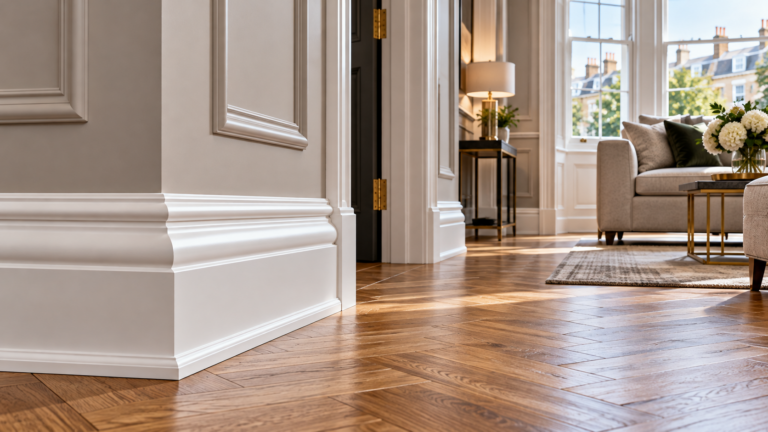
A beautifully decorated room deserves a finishing touch that connects its walls, flooring, and architectural features. While furniture and wall colours often receive the most attention, skirting boards play an equally important role in creating a complete interior. An ogee MDF skirting board offers a timeless combination of decorative detailing, smooth surfaces, and practical functionality, making it a popular option for traditional and contemporary UK homes.
The distinctive curved profile adds character without overpowering the surrounding design. In addition, medium density fibreboard provides a consistent surface that can be primed and painted to complement different interior styles.
However, choosing the correct skirting involves more than selecting an attractive shape. Board height, thickness, material quality, installation methods, and finishing techniques all influence the final appearance.
This guide explores seven practical design ideas, explains how to choose suitable dimensions, and provides useful installation and maintenance advice.
What Is an Ogee MDF Skirting Board?
An ogee MDF skirting board is a decorative interior moulding manufactured from medium density fibreboard. It fits along the bottom of a wall, covering the junction between the wall surface and the flooring.
Its defining feature is the ogee profile, which contains a flowing combination of concave and convex curves.
This traditional shape creates subtle shadows and adds visual interest to otherwise plain wall surfaces.
Unlike basic square edge skirting, the ogee design provides a more decorative appearance while remaining versatile enough for many interior styles.
Understanding the Traditional Ogee Profile
The ogee profile has long been associated with traditional British interior architecture.
Its curved shape is particularly suitable for Victorian and Edwardian inspired spaces, where decorative mouldings help establish the character of a room.
However, it is not limited to period properties.
When paired with modern flooring, neutral paint colours, and simple furnishings, the same profile can bring a restrained traditional detail into a contemporary home.
Why Is MDF Used for Skirting Boards?
Medium density fibreboard is made from wood fibres combined with resin and manufactured into consistent panels.
It offers a smooth surface without the natural knots or grain variations commonly found in solid timber.
As a result, manufacturers can machine detailed skirting profiles with consistent dimensions.
MDF also accepts suitable primers and paint finishes, making it useful for projects where homeowners want uniform colour and appearance.
Nevertheless, MDF quality varies. Moisture resistance, density, surface preparation, and manufacturing standards should influence product selection.
Why Ogee MDF Skirting Boards Are Popular in UK Homes
Ogee skirting combines decorative value with everyday practicality.
The profile suits a wide range of houses, from traditional terraces to recently renovated family homes.
Moreover, manufacturers offer different heights, thicknesses, lengths, and finishes, allowing homeowners to choose products that suit their rooms.
A Classic Appearance That Remains Versatile
Traditional architectural features often remain attractive because they create balanced proportions.
Ogee moulding adds definition along the base of the wall without requiring elaborate decorative work.
Its appearance can be subtle or prominent depending on the selected height and curve.
A Smooth Surface for Painting
A well prepared MDF surface can produce an even painted finish.
Homeowners can choose white, cream, grey, or other suitable colours to coordinate with their decorating scheme.
Factory primed options can also reduce preparation work.
Practical Protection for Lower Walls
Skirting helps protect the base of walls from everyday contact during cleaning, furniture movement, and normal household activity.
It also conceals the junction between flooring and plasterwork.
However, skirting does not replace suitable wall construction or solve underlying damp problems.
7 Stunning Ogee MDF Skirting Board Design Ideas
The right skirting can improve how a room looks and feels. These seven ideas focus on proportion, colour, architectural style, and practical details that influence the finished result.
1. Choose Taller Ogee Skirting for Elegant Living Rooms
Taller skirting can create a stronger architectural feature in a spacious living room.
It draws attention to the lower wall and helps establish a more traditional decorative style.
In UK properties with generous ceiling heights, taller boards often complement picture rails, cornices, and decorative door frames.
How to Select the Right Height
Commonly available heights include approximately 70mm, 95mm, 120mm, 145mm, and taller options.
However, exact dimensions depend on the manufacturer.
For rooms with standard ceiling heights, a moderate skirting height often creates a balanced appearance.
In larger period rooms, taller profiles may work better.
Why Room Proportions Matter
An oversized skirting board can make a small room appear visually crowded.
Similarly, very narrow skirting may seem insignificant in a room with high ceilings and substantial architectural detailing.
Therefore, evaluate the complete wall rather than the skirting alone.
Consider the relationship between ceiling height, door architraves, floor area, and furniture.
2. Use White Ogee MDF Skirting for a Timeless Finish
White skirting remains a versatile choice in British homes.
It creates a clean boundary between walls and floors while allowing furniture, flooring, and decorative accessories to take visual priority.
White ogee MDF skirting board designs work particularly well with warm neutral walls, soft grey interiors, and natural timber flooring.
Creating Contrast With Wall Colours
White skirting can provide a clear contrast against darker paint colours.
For example, deep green or navy walls paired with white decorative mouldings can create a traditional yet sophisticated appearance.
Alternatively, pale cream walls and white skirting offer a softer effect.
The best option depends on lighting, room size, and the desired atmosphere.
Choosing the Right White Paint
Not all white paints appear identical.
Some have cooler undertones, while others contain warmer shades.
Compare samples in the actual room before making a final decision.
A consistent paint finish across skirting boards, doors, and architraves can help create a coordinated appearance.
3. Combine Ogee Skirting With Traditional Architectural Features
Ogee moulding complements decorative features found in many period inspired interiors.
These may include panelled doors, ceiling cornices, picture rails, and wall panelling.
Using compatible profiles can help connect separate architectural details.
Matching Skirting With Door Architraves
Door architraves frame the opening between the wall and door lining.
Choosing a compatible style helps prevent the skirting and door frame from appearing unrelated.
Some manufacturers offer matching ogee architraves, while others provide complementary profiles.
An exact match is not always necessary.
However, the proportions and level of decoration should feel consistent.
Combining Skirting With Wall Panelling
Decorative wall panelling can create depth on otherwise plain surfaces.
Ogee skirting can provide an attractive lower boundary beneath these features.
For a more traditional appearance, use restrained colours and consistent moulding details.
Avoid combining too many competing decorative profiles in a small room.
A balanced design usually has one main architectural feature supported by simpler surrounding elements.
4. Choose Moisture Resistant MDF for Suitable Rooms
Material selection is particularly important in areas exposed to changing humidity.
Moisture resistant MDF is widely available for interior skirting applications.
It is manufactured to provide improved resistance to moisture compared with standard MDF.
However, moisture resistant does not mean waterproof.
Where Moisture Resistant Boards Can Be Useful
Suitable products may be considered for kitchens, utility rooms, and other interior locations where occasional humidity occurs.
The chosen board must still be appropriate for the actual conditions.
For example, a frequently wet floor or persistent water leak can damage exposed MDF.
Protecting Exposed Edges
Cutting an MDF board exposes the internal fibres.
These edges can absorb moisture more readily if left unprotected.
Therefore, use a suitable primer or sealing system on exposed cuts, following the manufacturer’s recommendations.
Why Damp Problems Must Be Resolved First
Skirting should never be used simply to conceal active dampness.
If a wall shows persistent moisture, mould, or water damage, investigate and correct the underlying cause before installing new boards.
This helps protect both the skirting and the surrounding building materials.
5. Use Ogee Skirting With Modern Flooring
Traditional mouldings can work surprisingly well with contemporary flooring.
The gentle curves of ogee skirting soften the transition between straight wall surfaces and modern floor finishes.
This makes the profile suitable for rooms with laminate, engineered wood, luxury vinyl, or ceramic tiles.
Pairing Ogee Skirting With Oak Flooring
Natural oak flooring offers warmth and texture.
White painted ogee skirting creates a simple visual boundary that allows the wood grain to remain prominent.
This combination suits both modern family homes and traditional living spaces.
Coordinating Skirting With Laminate Flooring
Laminate flooring is commonly installed as a floating floor.
Such flooring generally requires an expansion space around the room perimeter according to the flooring manufacturer’s instructions.
Skirting can cover this gap without restricting the floor’s necessary movement.
The skirting should be fixed to the wall rather than through the floating flooring system.
Creating a Neat Edge Around Tiles
With tiled floors, the junction between the tile and skirting should be considered during installation.
Choose finishing materials suitable for the floor construction and expected cleaning conditions.
An appropriate sealant may be required in some locations, but a visible joint should not automatically be filled without considering movement and moisture requirements.
6. Paint Ogee Skirting in Contemporary Colours
Although white remains popular, coloured skirting can create a distinctive interior.
Painting skirting to match the walls produces a unified effect, while contrasting shades can highlight decorative detailing.
The ogee profile responds particularly well to light and shadow because its curved surface changes how the paint appears under different lighting conditions.
Creating a Coordinated Interior
Painting walls and skirting in the same shade can make a room feel visually continuous.
This technique can work in bedrooms, living rooms, and hallways where a calm appearance is preferred.
It also allows the shape of the skirting to remain visible through natural shadows rather than strong colour contrast.
Introducing Darker Finishes
Charcoal, forest green, and deep blue can create a more dramatic appearance.
These colours may be particularly effective alongside lighter walls and carefully selected flooring.
However, darker paint can reveal dust and surface marks more readily.
Consider how frequently the area is used before choosing the final finish.
7. Match Ogee Skirting With the Character of Your Property
The most successful skirting design complements the building rather than competing with it.
A period property may benefit from taller decorative profiles, while a modern flat might look better with a more restrained ogee shape.
Traditional Victorian Inspired Interiors
Victorian inspired rooms often feature generous skirting heights, panelled doors, and decorative plaster details.
Ogee moulding can reinforce this character when used with suitable proportions.
However, homeowners renovating genuine historic properties should consider whether original timber mouldings can be retained or repaired.
Replacing original features is not always the most appropriate conservation choice.
Contemporary Homes
Modern homes can also incorporate ogee MDF skirting.
Choose a moderate height, a simple painted finish, and compatible door trim.
The result can offer traditional character without making the room feel overly decorative.
How to Choose the Right Ogee MDF Skirting Board Size
Selecting the correct dimensions is essential for appearance and installation.
Manufacturers commonly offer several heights and thicknesses.
For example, some UK product ranges include 18mm and 25mm thickness options, while others offer thinner profiles.
Lengths also vary, with products available in approximately 2400mm, 3050mm, and 4200mm sections.
These are examples of available specifications rather than universal standards.
Understanding Height and Thickness
Height determines how far the skirting extends up the wall.
Thickness determines how far it projects into the room.
If you are replacing existing skirting, check whether the new thickness will align with your door architraves.
Also consider whether the new height will cover previous paint lines or damaged plaster.
Measuring the Required Quantity
Measure the length of every wall where skirting will be installed.
Then subtract openings that will not require skirting, such as doorways.
Add a sensible allowance for cutting waste, corners, and mistakes.
An allowance of around 10 percent can serve as an initial estimate for a straightforward room, although complicated layouts may require more.
For example, a room requiring 20 metres of finished skirting may need approximately 22 metres of material when allowing 10 percent extra.
Finally, check the available board lengths to calculate how many full sections are needed.
How to Install Ogee MDF Skirting Board Correctly
Proper installation influences both durability and appearance.
A neatly cut and carefully fixed skirting board will generally look more professional than one fitted without adequate preparation.
While some homeowners complete straightforward installations themselves, complex walls and detailed joinery may benefit from professional fitting.
Prepare the Walls and Working Area
Remove any existing skirting carefully and inspect the wall behind it.
Repair loose plaster and identify significant unevenness before installing the new material.
Make sure the surface is sound, clean, and suitable for the chosen fixing method.
Before drilling or driving fixings, check for hidden electrical cables and plumbing.
Measure and Cut the Boards
Measure each section individually because rooms are not always perfectly square.
Use appropriate cutting tools and support long boards securely.
A fine tooth saw or suitable mitre saw can produce controlled cuts when used correctly.
Cutting Internal and External Corners
External corners commonly use mitre joints.
The cut angles must match the actual corner rather than assuming every wall forms a perfect right angle.
For internal corners, a scribed joint often creates a neater fit.
This involves cutting one board square and shaping the adjoining board to follow its decorative profile.
Because ogee skirting contains curves, practice the scribing technique on an offcut before attempting a visible joint.
Fix the Boards Securely
Suitable grab adhesive can work for certain installations when the wall and product are compatible.
Mechanical fixings may also be needed depending on the wall construction, board size, and manufacturer’s instructions.
Check alignment before the adhesive cures or the final fixings are secured.
Avoid forcing an excessively bowed board against a badly uneven wall without correcting the underlying issue.
Control MDF Dust During Cutting
Cutting and sanding MDF generates fine dust that should not be inhaled.
The UK Health and Safety Executive recommends suitable extraction to control exposure.
Appropriate respiratory protection may also be necessary, especially during powered cutting or sanding.
Use suitable equipment, follow workplace safety requirements, and clean dust with an appropriate filtered vacuum rather than sweeping it into the air.
How to Paint Ogee MDF Skirting for a Professional Finish
Painting helps protect the board surface and creates the final decorative appearance.
The exact preparation depends on whether you purchase unprimed, factory primed, or fully finished MDF skirting.
Prepare the Surface
Inspect the board for minor imperfections.
Factory primed products may need only light preparation according to the manufacturer’s instructions.
Raw MDF generally requires an appropriate primer before applying decorative paint.
Pay particular attention to exposed edges and cut ends.
Fill Small Gaps Carefully
After installation, small gaps between the wall and skirting may be filled with suitable decorators caulk.
Allow the product to cure according to its instructions.
Use an appropriate filler for visible fixing holes and suitable joints where required.
Avoid applying excessive filler over the decorative ogee curve, as this can obscure its shape.
Apply the Final Paint Finish
Satin, eggshell, and gloss paints are commonly used for interior woodwork and compatible MDF mouldings.
Satin provides a gentle sheen, while eggshell usually creates a softer appearance.
Gloss produces stronger reflections and makes the decorative profile more noticeable.
Choose paint designed for the prepared substrate and follow the manufacturer’s drying and recoating instructions.
Common Ogee MDF Skirting Board Mistakes to Avoid
Several avoidable mistakes can affect the quality of a skirting installation.
Understanding them before starting helps reduce wasted materials and additional decorating work.
Selecting the Wrong Profile
Different manufacturers may use the name ogee for slightly different curves.
When extending existing skirting, compare actual profile samples or technical drawings rather than relying on the product name.
Ignoring Exposed MDF Edges
Unsealed cut edges can absorb moisture and affect the finish.
Apply a suitable sealing system before the installation is completed, particularly where the product is exposed to occasional humidity.
Installing Boards Over Damp Walls
Persistent dampness can damage skirting and surrounding decorations.
Investigate moisture problems before covering the area.
Rushing the Painting Process
Painting before adhesive, filler, or caulk has cured can produce visible defects.
Follow the recommended curing and drying times for each product.
Overlooking Door Frame Alignment
A skirting board that projects awkwardly beyond the door architrave can make an otherwise neat room look unfinished.
Check the relationship between the skirting thickness and door trim before ordering.
Is Ogee MDF Skirting Board Better Than Solid Wood?
Neither material is automatically the best option for every property.
The choice depends on appearance, intended use, budget, maintenance, and environmental conditions.
Benefits of MDF Skirting
MDF offers a consistent manufactured surface and is available in detailed profiles.
It has no natural knots and can be supplied factory primed, which may reduce decorating preparation.
It is often an attractive option for homeowners seeking painted interior mouldings.
Benefits of Solid Wood Skirting
Solid timber can provide authentic wood grain and may be more suitable where a natural stained finish is required.
Depending on the species and construction, it may also offer different repair and durability characteristics.
However, timber can respond to changes in moisture and may require additional preparation before finishing.
For painted internal skirting in suitable conditions, MDF is often a practical choice. Where moisture exposure, conservation requirements, or natural timber appearance are important, another material may be preferable.
How to Maintain Ogee MDF Skirting Boards
Routine care helps preserve the painted finish and decorative profile.
Remove dust using a soft cloth or suitable vacuum attachment.
For minor marks, use a lightly dampened cloth and a cleaning method compatible with the paint.
Avoid saturating the surface, particularly around exposed joints or damaged paint.
Inspect vulnerable areas occasionally for chipped coatings, loose joints, and signs of moisture damage.
Small paint defects can often be repaired by preparing the affected area and applying compatible touch up paint.
However, swelling caused by water penetration may require the damaged section to be replaced.
Frequently Asked Questions
What is an ogee MDF skirting board?
An ogee MDF skirting board is an interior moulding made from medium density fibreboard with a decorative curved profile, commonly used to finish the junction between walls and floors.
Is ogee MDF skirting board suitable for modern homes?
Yes. Its curved design can complement contemporary interiors when paired with suitable proportions, coordinated architraves, and restrained paint finishes.
What height should ogee MDF skirting board be?
Common options include approximately 95mm, 120mm, and 145mm. The best height depends on room proportions, ceiling height, and existing architectural details.
Can ogee MDF skirting board be used in bathrooms?
Moisture resistant MDF may be suitable for certain bathroom locations when correctly sealed and protected. It should not be treated as waterproof or installed where persistent wetting occurs.
Can you paint an ogee MDF skirting board?
Yes. MDF skirting can be painted with compatible products. Raw MDF requires suitable priming, while factory primed boards may need less preparation.
How do you fix ogee MDF skirting board to a wall?
Depending on the wall and product, suitable grab adhesive, mechanical fixings, or a combination may be used. Always follow the manufacturer’s installation instructions.
Conclusion
An ogee MDF skirting board is a versatile finishing detail that brings traditional character and a polished appearance to many UK interiors. By choosing the right profile, height, material quality, and paint finish, homeowners can create a balanced design that complements both modern and period inspired rooms. Careful measurement, safe installation, and proper moisture protection are essential for reliable performance. With thoughtful planning and routine maintenance, ogee skirting can remain an attractive and practical feature of a well finished home.